
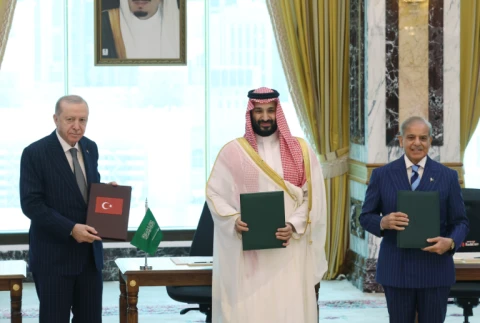
The Mecca Joint Defense Agreement between Türkiye, Saudi Arabia and Pakistan could mark an important turning point in the regional security architecture. By declaring that an armed attack against one party will be regarded as an attack against all three, the agreement goes beyond conventional defense cooperation and lays the foundation for collective deterrence.
Yet it should not be interpreted simply as a response to declining confidence in the United States, a balancing coalition against Iran and Israel, or an emerging new military bloc. Each explanation captures part of the regional context but misses the agreement’s broader significance. The Mecca agreement represents an attempt by three middle powers to move from consuming externally provided security toward jointly producing it.
Its deeper logic lies in collective strategic autonomy: the capacity to preserve strategic choice, distribute security risks and mobilize complementary resources without placing the regional order under the control of a single external power. This does not mean that the three countries seek independence from existing alliances or share identical threat perceptions. Their cooperation rests on a more limited recognition: no one can manage the emerging security environment alone, while excessive dependence on a single security provider creates strategic vulnerability.
The agreement must therefore be assessed through three connected questions: how regional order is fragmenting, how the parties can convert different forms of power into collective capacity and whether they can reconcile shared responsibilities with national autonomy.
From consumption to production
The Mecca agreement has emerged from a structural transformation in the regional order. The central issue is not simply an American withdrawal from the Middle East. The U.S. remains militarily present and politically influential. The deeper problem is the declining predictability of its security guarantees and the widening gap between the threats confronting regional states and the protection offered by the existing order.
Regional governments increasingly question when, how and for how long Washington will intervene in a crisis. As great-power competition shifts toward the Asia Pacific, American security policy has become more selective. Washington also expects its regional partners to assume a larger share of the defense burden. American protection remains important, but regional actors no longer consider it sufficient by itself.
They are therefore creating additional security channels, diversifying partnerships and reducing excessive dependence on a single provider. Europe's pursuit of greater defense capacity after the war in Ukraine and arrangements such as the Mecca agreement share this structural foundation: both respond to uncertainty surrounding established guarantees.
A second transformation concerns the regionalization of conflict. The war that began in Gaza gradually produced a wider theater involving Lebanon, Syria, Iraq, Yemen, Iran and the Gulf. Missile and drone attacks, threats to energy infrastructure and disruptions to maritime routes have connected security theatres previously treated as separate.
Geographical distance consequently provides less protection. Missiles launched from Iran or Yemen can threaten Gulf energy facilities. A crisis in the Strait of Hormuz can affect Saudi, Turkish and Pakistani economic security simultaneously. Instability in Syria or the Eastern Mediterranean can quickly become a direct Turkish concern. Air and missile defense, maritime security, cyber capabilities, intelligence sharing and critical infrastructure protection now form parts of the same strategic problem.
The erosion of constraints on military power compounds this danger. Israel’s widening operations, Iran’s missile and drone capabilities and the involvement of armed non-state actors increase the likelihood that a localized crisis will escalate into a regional war. The region still contains military bases, bilateral agreements and external commitments, but it lacks an accepted mechanism capable of controlling escalation and preventing conflicts from spreading across borders.
The Mecca agreement forms part of a wider trend that is simultaneously responsive and order-building. The declaration establishing the Multinational Maritime defense Alliance in Riyadh on July 30, 2026, illustrates this shift. Bringing together states from the Gulf, the Red Sea, Africa and South Asia, the initiative envisages a permanent headquarters, joint command, command-and-control center and combined maritime operations center. Its significance lies in identifying the institutions required to produce maritime security rather than merely expressing political solidarity.
The distinction between security consumption and security production is crucial. A security-consuming state depends primarily on an external actor to define threats, provide capabilities and manage escalation. A security-producing state can assess threats, mobilize resources, protect infrastructure and influence its security environment.
The Mecca agreement indicates that its members want to become joint producers of security. Saudi Arabia seeks to convert economic power into strategic depth. Türkiye seeks to transform its defense-industrial and operational capabilities into wider regional influence. Pakistan seeks to translate its military strength into a more consequential role beyond South Asia. The agreement provides a platform through which these ambitions can be coordinated.
Iran’s competing vision of order
Iran’s post-war strategy adds another dimension to the regional order deficit. Although Iran suffered substantial military and infrastructural damage during the war, Tehran is attempting to shape the postwar environment through renewed asymmetric deterrence. Rather than restoring conventional military parity, it seeks to preserve its ability to impose costs across several theaters, against different actors and at moments of its choosing.
This strategy rests on two pillars. The first is distributed deterrence. Iran's missiles, drones, cyber capabilities, maritime assets and relationships with armed groups allow it to threaten regional states without necessarily entering a conventional war. Tehran’s message is deliberately broad: Iran may have been weakened, but it can still widen the geography of conflict and transfer the costs of escalation to states that support operations against it.
Through this approach, Iran compensates for its conventional weakness by generating uncertainty. Regional states cannot know where, when or through which instrument Tehran might respond. Military bases, energy facilities, ports and maritime routes can all become links in the same retaliatory chain. Uncertainty itself becomes an instrument of deterrence.
The second pillar is the weaponization of the Strait of Hormuz. Tehran increasingly presents Hormuz as more than a strategically important waterway. Its references to the Suez Crisis seek to construct a historical narrative in which resistance at a vital chokepoint becomes a source of national legitimacy, regional influence and international bargaining power.
Hormuz therefore serves simultaneously as a symbol of sovereignty, an instrument of economic coercion and a means of connecting Iranian security to the stability of the global economy. Tehran’s message is that Iran cannot be attacked, isolated or excluded from the emerging order without imposing costs on energy markets and commercial shipping.
These two pillars reinforce each other. Distributed deterrence allows Iran to spread insecurity across the region, while the weaponization of Hormuz internationalizes the costs of confrontation. Tehran aims to show that even a weakened Iran can obstruct any regional order constructed against it.
The Mecca agreement partly responds to this strategy, although it is not exclusively an anti-Iranian alliance. Its members maintain different threat hierarchies and important political and economic relations with Tehran. Nevertheless, one of its central functions is to prevent Iran from transforming asymmetric disruption and escalation control into a durable regional advantage.
The agreement thus reveals two competing approaches to regional order. Iran seeks influence by distributing vulnerability, producing uncertainty and weaponizing critical geography. Türkiye, Saudi Arabia and Pakistan seek to reduce vulnerability through distributed defense, strategic resilience and jointly produced security. The emerging struggle is therefore less a confrontation between two rigid blocs than a competition between two visions of order.
Toward collective autonomy
The three countries possess different but potentially complementary resources. Türkiye contributes operational experience, NATO-standard capabilities and an advanced defense industry. Pakistan provides a large military, established defense institutions, missile capabilities and nuclear status. Saudi Arabia, on the other hand, brings financial resources, strategic geography, influence over energy markets and political weight in the Arab and Islamic worlds.
This combination creates the possibility of triangular-structured interdependence. Each member contributes assets that the others cannot easily reproduce. The objective is not to eliminate dependence but to restructure it. Rather than relying asymmetrically on one great power, the three countries can build selected forms of mutual dependence in air defense, intelligence, logistics, ammunition production, maritime security and infrastructure protection.
Complementary resources, however, do not automatically create collective power. Saudi financial capacity, Turkish technology and Pakistani military strength will remain separate national assets unless the parties establish mechanisms that allow them to operate together. The agreement’s central challenge is converting three different power profiles into a common strategic effect.
This architecture could rest on three layers. The first would be deterrence by denial. Joint early warning, intelligence fusion, layered air and missile defense, electronic warfare and maritime surveillance would improve each member’s ability to prevent or absorb attacks.
The second would be strategic resilience. Common ammunition reserves, maintenance facilities, protected energy infrastructure, alternative logistical corridors, redundant communications and contingency planning would allow the parties to sustain essential functions during a prolonged crisis.
The third would involve graduated response options, ranging from diplomatic coordination and intelligence support to cyber operations, logistical assistance, military deployments and, in extreme circumstances, direct force. Multiple response levels would prevent collective defense from becoming an automatic mechanism for uncontrolled escalation.
This requires commitment elasticity. The principle that an attack against one will be treated as an attack against all establishes political clarity, but it need not require identical military responses from every member. Too much ambiguity would weaken deterrence, while excessive automaticity could entangle Türkiye and Pakistan in a Saudi-Iranian confrontation or pressure Saudi Arabia to enter crises originating in South Asia or the Eastern Mediterranean.
The agreement’s success should therefore not be measured solely by whether all three countries enter the same war. A better test is whether it expands their strategic options, strengthens resilience and enables coordinated action without forcing choices that contradict their vital interests. Collective strategic autonomy succeeds when cooperation increases each member’s capacity to choose. It fails when one party transfers the costs of its national conflicts to the others.
For Türkiye, this approach complements NATO membership and relations with the U.S. while reducing asymmetric dependencies. Saudi Arabia gains strategic depth without completely breaking with Washington. Pakistan can strengthen its historical role in Saudi security while preserving relations with Iran and China. The agreement creates an additional strategic layer rather than an exclusive geopolitical orientation.
The Mecca agreement should ultimately be understood as an experiment in collective strategic autonomy. Its importance does not depend on whether it immediately becomes a conventional military alliance. The decisive question is whether three middle powers can jointly produce security, transform complementary resources into collective capacity, and preserve national autonomy while assuming shared responsibilities. If they succeed, the agreement could offer a new model of middle-power cooperation in a fragmented international order.
[Daily Sabah, August 10, 2026]
