
The trajectory of military expenditure is among the most tangible indicators of how states prioritize their economic resources in response to security imperatives. Over the last 25 years, the volume of military spending and its share of Gross Domestic Product (GDP) have exhibited diverse trends, heavily influenced by shifting regional and global dynamics. Based on SIPRI data, this analysis reveals the evolving landscape of global defense spending across selected key actors.
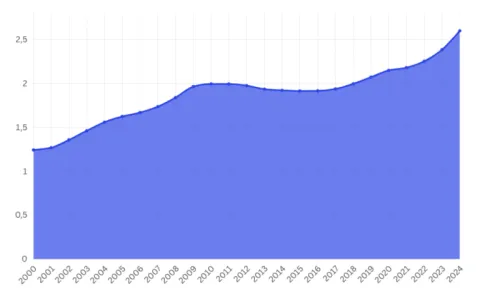
Since the turn of the millennium, global military expenditure has maintained a steady upward climb. Data shows that spending has surged from approximately $1.24 trillion in 2000 to a staggering $2.60 trillion by 2024. Following a relatively stagnant period between 2010 and 2018, there has been a marked acceleration since 2020. This spike is largely attributable to escalating geopolitical tensions and the proliferation of regional conflicts worldwide.
Total World Military Expenditures (2000 - 2024)
While world averages provide a baseline, key actors such as the United States, Russia, Israel, Saudi Arabia, and Greece have consistently remained above the global mean. Between 2000 and 2024, military spending in constant prices increased in almost all analyzed countries, with Egypt being the sole exception. However, the "defense burden"—the share of military spending within GDP—has shown more nuanced fluctuations.
The most dramatic shifts have occurred in Israel and Russia. Driven by intensified conflict, Israel’s defense spending reached 8.78% of its GDP in 2024, exceeding $45 billion. On the other hand, following the onset of major military operations post-2021, Russia’s spending escalated to $150 billion (in constant prices), bringing its GDP share to 7.05%.
As a dominant regional power, Saudi Arabia maintained a significant presence with $78.9 billion in spending in 2024, representing 7.30% of its GDP, despite some volatility since its 2015 peak. In contrast, Iran’s spending stood at $6.6 billion in 2024, with its GDP share (2.01%) hovering slightly below the global average.
Military Spending (US Dollars at Constant Prices)
The United States has continued its high-volume spending, reaching approximately $968 billion in 2024. Throughout the last two decades, the U.S. has managed to keep its defense burden relatively stable, fluctuating between 3.1% and 4.8% of GDP.
In the Eastern Mediterranean, Turkey and Greece present a compelling comparison. Both nations saw their GDP shares decline from the 3.6% levels seen in the early 2000s toward the mid-2010s. Turkey’s military expenditure began to climb again in constant prices after 2020, reaching $21,8 billion in 2024. Its GDP share of 1.92% aligns closely with the global average. Greece, however, continues to carry a disproportionately high defense burden relative to its economic scale, with a 3.13% GDP share. Egypt, on the other hand, has seen a decline in spending volume recently, with its GDP share (0.67%) remaining notably low compared to its regional peers.
Military Expenditure as a Percentage of GDP (%)
Ultimately, global military expenditure has reached its highest volumetric levels of the last quarter-century. While the global average share of GDP remained stable for much of this period, it has shown an upward trend in recent years.