
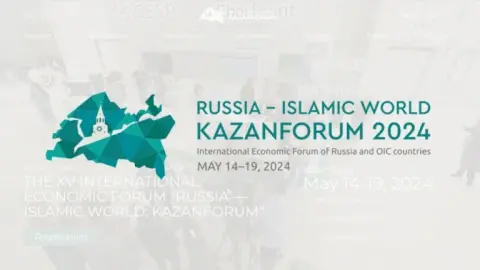
The 15th International Russia–Islamic World Kazan Economic Forum – KazanForum 2024
The 15th International Russia–Islamic World Kazan Economic Forum (KazanForum 2024) will be held between May 14–19, 2024, in Kazan, the capital of the Republic of Tatarstan. The forum aims to bring together leading experts in economics and finance from across the Islamic world. In 2023, more than 16,000 people from 80 countries—including 57 members of the Organization of Islamic Cooperation (OIC)—attended the event. KazanForum 2023 gained federal status through a decree signed by Russian President Vladimir Putin. As a result, the forum became one of the three largest economic forums held annually in Russia, alongside the St. Petersburg International Economic Forum and the Eastern Economic Forum in Vladivostok, both in terms of participation and significance.
It is evident that Russian state institutions have shown growing interest in KazanForum in recent years. Particularly after the onset of the Russia-Ukraine war and the imposition of heavy sanctions by Europe and the United States, Russia has been seeking alternative partnerships and markets. Russia’s substantial Muslim population offers a strategic advantage in developing cooperation with Islamic countries. In recent years, investments—especially from OIC member states such as Türkiye, Iran, Saudi Arabia, and the United Arab Emirates—have increased in Russian regions populated by Muslims. In recognition of the sensitivities of Muslim investors, the Russian government has made significant progress in Islamic and participation banking. Kazan-based Ak Bars Bank has also begun experimenting with Islamic banking models.
The forum aims to strengthen commercial, economic, scientific, technical, academic, social, and cultural relations between OIC countries and various regions of the Russian Federation. Another goal is to encourage the development of Islamic financial institutions in Russia and worldwide.
The Islamic World in a Multipolar World
With the concept of a "multipolar world," Russia fundamentally critiques the current international system, which it argues is flawed and serves only the interests of the United States. This criticism has led Moscow to develop a new geopolitical concept since 2008. Within this framework, Russia has sought to reduce its dependency on Europe and the United States and to establish new partnerships and opportunities. Organizations such as BRICS (Brazil, Russia, India, China, South Africa), the Shanghai Cooperation Organization, and the Eurasian Economic Union have been created to build alternative markets and alliances.
The Islamic world stands out as a region with significant cooperation potential for Russia, which is in need of new partners. Currently, 21 million Muslims live within Russia’s borders. Russia is also the country with the second-largest number of mosques in Europe, after Türkiye. Furthermore, many of the Muslim peoples in Russia—such as the Tatars, Uzbeks, Azerbaijanis, Kazakhs, and Kyrgyz—are of Turkic origin, leading to linguistic and cultural affinities.
Because of these factors, Tatarstan is emerging as an attractive region for Turkish investors. Accordingly, Türkiye is among the priority countries at KazanForum 2024. Currently, over 180 Turkish companies operate in Tatarstan, with total investments amounting to approximately 4 billion dollars. This figure is expected to increase in the coming years.
Alternative Logistics Routes
One of the prominent topics to be discussed at KazanForum 2024 is the International North-South Transit Corridor (INSTC). Ongoing conflicts in Gaza and attacks by the Houthis on commercial ships in the Red Sea have severely disrupted the global supply chain. At the same time, passage through the Panama Canal has been limited due to drought, further exacerbating logistics disruptions and significantly increasing costs.
In response, Russia aims to increase and accelerate freight transportation across Eurasia via the INSTC and the Northern Sea Route, offering alternatives to previously dominant maritime routes. By 2024, Eurasian logistics firms are expecting the INSTC rail corridor connecting the Indian Ocean and Persian Gulf to the Caspian region and onward to Russian ports in the Baltic and Northern Seas to become fully operational.
Iran has already completed construction of the final segment of its railway network, connecting the city of Rasht to a port on the Caspian Sea. In parallel, the INSTC’s western and eastern land routes around the Caspian Sea are being developed via Azerbaijan, Kazakhstan, and Turkmenistan. Additionally, in 2023, Russia and Iran signed an agreement to build the final railway section between Rasht and Astara along the corridor’s western route.
According to KazanForum experts, the INSTC will enable a fast and uninterrupted logistics connection between Russia and the Persian Gulf countries and Europe. Delivery times for containers are expected to be cut by more than half compared to current shipping routes. For instance, products shipped from St. Petersburg to Mumbai currently take 30–45 days via the Suez Canal. Through the INSTC, this transit time could be reduced to 10–20 days.
Estimates suggest that transportation costs may decrease by 30–40%. Logistics volume is expected to rise significantly, enhancing transit capacity and expanding member countries’ access to external markets. Russia plans to invest 280 billion rubles (approximately $3 billion) in the development of the INSTC by 2030.
According to Russian Deputy Prime Minister Marat Khusnullin, the construction of the INSTC is closely linked to the increasing interest of Muslim countries in Russian agricultural and halal products. For this reason, the INSTC has become one of the key topics at KazanForum 2024. The new logistics corridor is expected to deliver food and other agricultural industrial products to consumers in Central Asia, the Persian Gulf, and Africa. Thus, the INSTC is set to make a tangible and practical contribution to global food security.
Conclusion
In short, KazanForum 2024 represents an event aimed not only at enhancing cooperation with OIC member states but also at addressing pressing logistical challenges of the modern world. The decisions and new agreements resulting from this forum are likely to have a direct impact on Russia’s strategic position, economy, and connectivity.
