
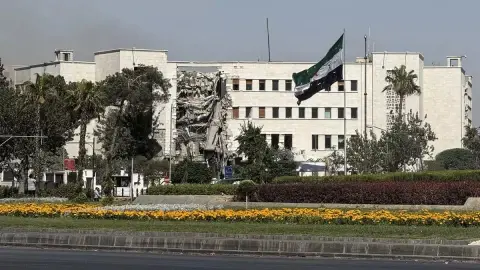
Israel is playing a 'dirty' game in the Levant geography by trying to shape the region through ethnic and religious minorities like the Kurds and the Druze. After Iran's withdrawal from Syria, and Ahmed al-al-sharaaaa's brand-new government taking charge, Israel played the first hand of its two cards through the Druze community. Let’s examine the background of the latest tension that started with Israeli strikes on Suwayda and Damascus, in terms of subsequent regional scenarios and their impact on Türkiye.
What is the Current Situation?
Following the humanitarian disaster in Gaza, the occupation of southern Lebanon along the Litany River, “illegal settler terrorism” in the West Bank, the new occupation of more Syrian territory after Assad's removal, airstrikes on military infrastructure, and ultimately attacks on Iran, Israel has initiated a new move involving the Druze. On July 12, 2025, a commercial conflict between Druze and local Bedouin tribes in the Syrian city of Suwayda suddenly escalated into violence, prompting Israel to launch airstrikes claiming to protect the Druze from the Syrian national security forces, deployed by Damascus to maintain order. Israel struck the Syrian Defense Ministry and Syrian General Staff HQ in Damascus on July 16, following Israeli Defense Minister Israel Katz's remarks about targeting President al-Sharaa and another Israeli minister threatening his assassination. After the U.S. pressured Israel to stop the airstrikes, Syrian Defense Ministry personnel withdrew from Suwayda, but Israel also carried out airstrikes on the headquarters of the 107th Syrian Division in Tartus.
What is Israel's Purpose?
Because the powerful states in its immediate region have expelled the Jews throughout their nearly 3,500-year history, Israel has pursued a policy of limiting all its neighbors to “too much power to be a threat” to Israel. For this reason, Israel has always tried to keep the governments and state order in Egypt, Jordan, Syria, and Lebanon under control. On the one hand, it has exploited the sensitivities of these countries through its intelligence agencies. On the other hand, it has sought to shape the political and military dynamics and border configurations of the region. Due to the disproportionate power balance, it has also fought asymmetric threats from non-state actors, like Hamas and Hezbollah, using asymmetric methods.
In the aftermath of the Oct. 7 incursion, Israel, in the described mental state, executed the goals, methods, and practices relentlessly. In this context, the plan to destroy Palestine was implemented, while a major operation was carried out against Hezbollah in Lebanon. After withdrawing from Syria, Iran's nuclear program and military response capability were dismantled. Therefore, Iran, which was openly threatening Israel, was isolated, its prestige damaged. The possibility of Türkiye securing a stronger position in post-Assad Syria was discussed by Turkish and Israeli intelligence agencies in Baku, and the process was managed through a conflict prevention mechanism.
In line with the trend and as part of a long-term strategy, Israel has targeted Syria's military infrastructure after Ahmed al-Sharaa assumed control. After destroying its air, air defense, and ammunition depots, the new Syria has become more vulnerable to Israeli actions. In fact, Israeli troops advanced up to 25 kilometers (15.53 miles) from Damascus, creating a situation similar to the occupation of the Golan Heights. Additionally, Israel views al-al-sharaaa as a radical figure, and after it was unable to find an alternative to his government, Tel Aviv has openly used the Kurdish and Druze cards. Since its Kurdish card didn’t have the desired effect due to Ankara’s “Terror-free Türkiye” initiative, Israel did not hesitate to exploit the weaknesses created by the Druze.
A group of Druze in Suwayda, seeking help from Israel, has thus become its new proxy structure. Under the guise of protecting the religious minority, Benjamin Netanyahu’s government announced the creation of a “demilitarized” zone near the Israeli border. It has, however, launched a new program that exceeds this stated goal. In addition to the unilaterally annexed Golan Heights, the Druze-inhabited area of Suwayda and its surroundings has been destabilized by Israel with the aim of “annexing” it later. Therefore, the provoking of the Druze community is mainly related to Israel's territorial expansion policy. There is also a secondary goal of turning Syria into a new “Lebanon.”
What is the situation for the Damascus government?
Syria's military strength does not support a direct and balanced conflict with Israel. Due to the 2011 revolution and the civil war that followed, the country has lost its military, economic, and social capacity. After Assad fled to Russia, the country’s remaining military capacity was lost to Israeli attacks. Due to the harsh living conditions and the fact that the country was de facto divided into four parts for 10 years, the new government in Damascus has focused on two main priorities: 1. Maintaining Syria’s territorial integrity,
- Rebuilding the country.
Given that Syria “melted” and nearly collapsed during the revolution, the government chose to prioritize preserving territory and to rally internal and external support for reconstruction.
To that end, it signed a protocol with the PYD/YPG, leading to relative stability east of the Euphrates River. Meanwhile, military force was used without hesitation against an uprising of pro-Assad elements in Tartus and Latakia. In the end, the risk of conflict on both “home fronts” was avoided. Following Israel's provocation of the Druze, efforts were first made to reconcile with community leaders rather than resort to military action in Suwayda. However, military units were eventually sent to restore order. These lightly armed units were targeted by the Israeli air force. With no air or air defense capabilities, Syria was left vulnerable to Israel's military threats and its goal of territorial expansion. In this setting, al-Sharaa's current focus is on seeking reconciliation, gaining support from the U.S. and Türkiye, and preparing an asymmetric response. Given the positive momentum with the U.S., al-Sharaa prefers to strengthen Syria's defenses against Israel.
What is the US Approach?
While the U.S. has provided Israel with complete and unconditional support on its security issues, it finds itself in a contradiction due to the emerging situation in Syria. After meeting al-Sharaa in Riyadh, President Donald Trump appointed a special envoy for the country, lifted sanctions, and removed Hay'at Tahrir al-Sham (HTS) from Washington’s terror list. Because of al-Sharaa's accommodating and moderate foreign policy, there was a lack of counterarguments. As a result, the U.S. has shifted away from a military option, like the one pursued in Iran. Additionally, Israel was the one that stirred up Suwayda and attacked Syria. The Syrian government troops were deployed to maintain public order in Suwayda, where talks with Druze leaders brought peaceful solutions to the forefront. It would be inconsistent for the U.S. administration to criticize Damascus after the developments in Los Angeles. Secretary of State Marco Rubio's telephone diplomacy and his solution for Suwayda were implemented swiftly, and the U.S.' intentions and expectations were communicated to Israel.
The recent deterioration of relations between the U.S. and Israel is another issue. Trump will likely distance himself from Israel after Netanyahu's recent visit to Washington and his meeting with the Democratic Senate leader. Indeed, considering the visit of U.S. Ambassador to Ankara and Special Envoy for Syria Tom Barack, who knows the region well because of his Lebanese roots, to Damascus and his rhetoric against the PYD/YPG, the level of support Israel expects from the U.S. does not seem feasible. In this case, the U.S. administration will be caught between ignoring the issue and criticizing Israel. Moreover, on the same day that the EU discussed sanctions against Israel, its actions in Syria might bring a discussion and potential alignment between the U.S. and the EU.
What can Türkiye's position be?
Türkiye immediately condemned Israel's actions in a statement released by the Presidency’s Communications Director Burhanettin Duran. The Turkish Grand National Assembly also passed a resolution supporting Syria. Türkiye will surely follow a firm policy against Israel's Syrian agenda. First, Ankara will likely discuss Israeli aggression with Washington and Damascus, before raising the issue at regional and international organizations. At the U.N. Security Council, Foreign Minister Hakan Fidan strongly highlighted the Syrian issue on the same day as Gaza. Discussing the level of support for Damascus is also likely to be on the agenda. Druze community leader’s request for Israeli troops to intervene in Syria, his emphasis on joining Israel, and the PYD/YPG east of the Euphrates have agitated Türkiye. Reminiscent of the July 15, 2016, treacherous uprising and the “Syria project,” this situation is the country’s red line.
Israel's aggression against Syria, while the former and Türkiye have established a level playing field for conflict prevention, could be seen as a possible threat to Ankara’s military presence in Syria. Therefore, Türkiye should be prepared to implement a comprehensive strategy and adopt both symmetric and asymmetric measures. Otherwise, Israel's “slow but steady territorial expansion” might threaten regional peace and Türkiye's security perception. Additionally, viewing Syria as a “new Lebanon” serves as a reminder of the persistent instability. Consequently, it seems unlikely that Türkiye can remain silent regarding the current developments in Syria.
Israel's efforts to use the PYD/YPG card, along with the Druze, are also part of its typical strategy. Therefore, Türkiye should plan for the present and the future.
Conclusion and Possible Scenarios
Israel's agenda of territorial expansion and partition of Syria violates the war-ravaged country’s sovereignty. Therefore, one should be aware of the most likely, somewhat likely, and worst-case scenarios for Israeli aggression in Syria.
The most likely scenario is that Israel continues to create space in Syrian territory, under the pretext of “protecting the Druze and disarming Israel's borders,” then prolongs the issue over time to eventually annex it and implement an annexation plan. In this case, the approach of turning Syria into “1975 Lebanon” could be considered.
A likely scenario is that the U.S. intervenes, Israel delays the issue, and the status quo is maintained. This approach, which is currently being put into action, is not sustainable for Israel in the medium or long term. Therefore, it should be regarded as a temporary situation.
The worst-case scenario is that Israel initiates an escalation that could lead to prolonged military engagement across the entire Syria. In this context, the use of the PKK/PYD/YPG card east of the Euphrates River, attacks on the Syrian government forces, and provocation of the Assad regime’s remnants along the coast should be considered. This scenario, however, would directly prompt Türkiye to take security measures.
Both the “most likely” and the worst-case scenarios have drawbacks for Türkiye. Therefore, support for diplomacy with Washington and Damascus’ efforts to preserve Syria's integrity should be maintained in any case. However, Türkiye's clear stance on Israeli gamesmanship will only lead to a “concrete” reaction if Israel finds itself over its head. Türkiye will not accept Israel's attempts to influence Syria.
