
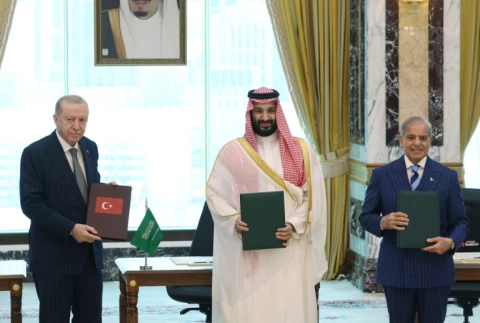
On 7 August 2026, Türkiye, Saudi Arabia, and Pakistan signed the Mecca Joint Defense Agreement, establishing a collective defense framework under which an armed attack against one party would be regarded as an attack against the others. The agreement therefore represents a potentially significant development in the evolving security architecture of the Middle East and its surrounding regions. At the first meeting of the Strategic-Political and Defense Committee, held on 31 August, the parties agreed to establish a permanent secretariat, expand joint military activities, deepen defense-industrial cooperation, and develop mechanisms for joint technology development and production. These decisions suggest that the agreement is moving beyond the level of a symbolic political declaration toward a more institutionalized security arrangement. The complementarity between Türkiye’s conventional military capabilities and expanding defense-industrial base, Saudi Arabia’s financial and economic resources, and Pakistan’s military and nuclear capabilities has made the Mecca Alliance an initiative with potentially important implications for regional balances of power. Against this backdrop, the alliance’s possible impact on Israel’s regional freedom of action and its long-standing qualitative military edge, the prospect of intensified security competition in Syria and the Eastern Mediterranean, the growing Greece–Greek Cypriot Administration of Southern Cyprus (GCASC)–Israel alignment, possible balancing strategies involving external actors such as the United States and India, and the strategic consequences of future enlargement constitute some of the principal questions surrounding the emerging regional security order.
Distinguished experts in their respective fields assess the Mecca Defense Alliance through detailed analyses and commentary.
Prepared by:
Sibel Düz, SETA
Contributors:
Tuğçe Ersoy Ceylan, İzmir Katip Çelebi University
Rıfat Öncel, SETA
Can Acun, SETA
Mustafa Caner, Sakarya University
Muhammed Hüseyin Mercan, Ankara Yıldırım Beyazıt University
Murat Aslan, Hasan Kalyoncu University
Mehmet Uğur Ekinci, Social Sciences University of Ankara
 Tuğçe Ersoy Ceylan
İzmir Katip Çelebi University
Considering Türkiye’s military capabilities, Saudi Arabia’s financial power, and Pakistan’s nuclear deterrent together, to what extent could this trilateral structure affect Israel’s perception of regional military superiority?
The significance of this trilateral framework from Israel’s perspective lies less in the individual capabilities of the three countries than in the possibility that these capabilities could become mutually complementary. Türkiye possesses one of the region’s most advanced conventional military capabilities and an increasingly sophisticated defense-industrial base; Saudi Arabia commands substantial financial resources and significant arms procurement capacity; and Pakistan is the only Muslim-majority state possessing nuclear weapons. In theoretical terms, therefore, their combined capabilities could constitute a considerable concentration of power.
The Mecca Joint Defense Agreement signed on 7 August represents an important threshold in this respect. The agreement stipulates that an armed attack against one member will be considered an attack against the others. At the first meeting of the Strategic-Political and Defense Committee on 31 August, the parties also agreed on the establishment of a secretariat, the conduct of joint activities, deeper defense-industrial cooperation, and joint technology development and production. The emerging structure is therefore moving beyond a symbolic political declaration and toward greater institutionalization.
From Israel’s perspective, one of the key questions surrounding the agreement is whether Pakistan’s nuclear capability would automatically translate into a nuclear umbrella extending over Türkiye and Saudi Arabia. Although official documents emphasize collective deterrence, they do not explicitly define arrangements for nuclear sharing or provide a formal commitment to extended nuclear deterrence. Consequently, at least in the initial phase, the agreement’s implications for Israel are likely to be strategic rather than constituting an immediate direct military threat.
It is also important to recognize that Israel’s regional strategy has never rested solely on maintaining absolute military superiority. A central objective has also been to prevent any regional actor or coalition from accumulating sufficient strategic weight to approach parity with Israel. The progressive integration of Turkish, Saudi, and Pakistani defense capabilities could therefore begin to erode Israel’s traditional understanding of its qualitative military edge (QME). In this sense, the alliance introduces the prospect of a potentially significant regional counterweight to Israel.
The broader transformation may therefore be that Israel will increasingly have to position itself not only within a threat environment centered on Iran, but within a more pluralistic regional security architecture characterized by the emergence of multiple centers of power. This is precisely why the Mecca Agreement is strategically significant: it has the potential to erode Israel’s perception of uncontested strategic predominance in the region.
 Rıfat Öncel
SETA Researcher
Could the development of capabilities such as integrated air defense, radar networks, early warning, and missile defense under the Mecca Agreement constrain Israel’s operational flexibility in the region?
Given its demographic constraints and lack of strategic depth, Israel has historically relied on technological and intelligence superiority, together with a doctrine centered on air dominance. The superiority it has achieved and sustained in these domains has provided Israel with significant strategic advantages in the wars it has fought across the region. Most recently, during the attacks launched against Iran, Israeli and U.S. forces demonstrated an ability to establish air superiority in a remarkably short period of time. The military and economic resources available to the Mecca Defense Alliance, combined with the defense vision articulated by its members, have the potential to significantly restrict Israel’s operational flexibility in the region. Two principal factors support this assessment.
First, under the Mecca Agreement, the allies have agreed to pursue joint technology development and collaborative defense production, both of which constitute critical elements of any meaningful defense arrangement. This provision is not detached from the existing pattern of defense relations among the parties. In recent years, Türkiye has concluded significant defense transactions with both Pakistan and Saudi Arabia. These arms transfers have also incorporated important dimensions such as co-production and technology transfer. The establishment of a Baykar AKINCI UAV production facility in Saudi Arabia and the construction of MİLGEM corvettes in Pakistani shipyards are among the most prominent examples. Given that the Mecca Defense Alliance is founded on the principle of collective defense, this trend can be expected to deepen further. Such cooperation could serve as a force multiplier in enhancing the military capabilities of the allied states.
Second, all members of the Mecca Defense Alliance have extensive experience operating sophisticated military platforms. Moreover, many of these platforms originate from the same principal supplier -the United States- which provides an existing foundation for interoperability. Türkiye and Pakistan, for example, are among the longest-standing and most extensive operators of the F-16. Although Saudi Arabia has never acquired the F-16, it operates approximately 230 F-15 aircraft. There is therefore a considerable basis for interoperability among the allies, one that could be elevated substantially through joint training and military exercises.
At the same time, an examination of these combat aircraft fleets and their associated inventories demonstrates that all three countries possess significant offensive capabilities. Offensive military capabilities remain among the strongest enablers of credible deterrence. Accordingly, stronger deterrence could be expected to reduce the likelihood of external aggression. Taken together, these factors could generate a substantial constraining effect on the operational flexibility of relevant regional actors, including Israel.
 Can Acun
SETA
Could a crisis between Israel and Türkiye in the Syrian theater become the first serious test of the collective defense mechanism? If this structure eventually develops into a framework incorporating joint intelligence, ISR, a common air-defense picture, or command-and-control infrastructure, how would this alter Israel’s operational planning vis-à-vis Iran, Syria, and the Gulf?
For some time, Türkiye has pursued a foreign-policy initiative aimed at shaping what may be described as a paradigm of regional ownership. Ankara’s approach rests on the assumption that regional disputes and conflict dynamics can only be resolved effectively through coordinated action by local actors. From this perspective, security cannot sustainably be imported from extra-regional powers.
Against this background, and with the contribution of evolving regional circumstances, the Mecca Defense Alliance has now emerged with the participation of Saudi Arabia and Pakistan. Although the alliance will require time to institutionalize and develop into a fully credible deterrent structure, several regional states already appear interested in exploring possible membership. Ultimately, the Mecca Alliance seeks to establish both a new regional military-security architecture and a model of economic integration, while also appearing to embody an approach intended, in particular, to constrain what is perceived as Israel’s aggressive and expansionist conduct. The emergence of the Mecca Alliance therefore increases the likelihood that two competing regional strategic approaches will come into sharper confrontation.
The states acting in coordination with Türkiye seek to build a regional order characterized by stability, the preservation of national sovereignty and territorial integrity, the elimination of armed non-state actors and terrorist organizations, the end of internal conflicts, and the absence of proxy warfare. Israel, by contrast, is seen through the prism of Zionist ideology as advancing a fundamentally opposing strategic vision, shaped by concerns arising from its lack of strategic depth and by an expansionist approach grounded in its interpretation of religious and historical claims. Within this framework, Israel is perceived as preferring not to be surrounded by strong states and as pursuing an interventionist strategy that exploits ethnic and sectarian fault lines in order to foster instability and internal conflict. From Gaza to Lebanon and Syria, Israel currently maintains control over or occupies border areas in several theaters. Türkiye’s regional ownership paradigm and the concept of “Greater Israel” therefore represent competing and potentially conflicting regional visions.
This does not necessarily imply that direct conflict is imminent. Nevertheless, Türkiye’s growing military deterrent, particularly its military presence in Syria, already constitutes a significant constraint on Israel’s ambitions in that theater. As Türkiye seeks to strengthen Syria militarily as a sovereign state, it is likely to expand its presence under the framework of existing and future security agreements. The establishment of the Mecca Alliance also raises the possibility that Saudi Arabia and Pakistan could, at some stage, deploy military elements in Syria. Syria itself may ultimately emerge as a potential member of the Mecca Alliance.
The alliance will require time to complete its institutionalization. Even so, the military deterrent generated by three countries with complementary capabilities is steadily increasing. In particular, the establishment of joint headquarters and command centers, the expansion of combined military exercises, greater integration among the members’ defense industries, and the creation of common air-defense networks, intelligence structures, and other integrated military mechanisms would further enhance both the alliance’s capabilities and its deterrent effect.
Under such conditions, the alliance could increasingly constrain and roll back Israel’s expansionist military posture, particularly in Syria. In the event of an armed confrontation, coordinated action by the alliance could also enable its members to establish a significant military advantage over Israel.
In such a scenario, Israel could be compelled to adopt a more restrained and rationalized regional posture and to abandon policies centered on territorial expansion and destabilization. Otherwise, it could face the prospect of a level of military defeat it has not previously experienced.
 Mustafa Caner
Sakarya University
Does Israel view the Mecca Agreement as an anti-Iran security framework, or as an independent regional bloc that could eventually constrain Israel’s own freedom of action?
Interpreting the Mecca Agreement as a move directed against Iran would be highly misleading. In outlining the process that led to the agreement, Foreign Minister Hakan Fidan pointed to December 2023. This was a period following 7 October, when Israel’s destabilizing military actions were intensifying, but before either the Twelve-Day War or the ongoing U.S./Israeli–Iranian war had emerged as defining elements of the regional security environment. In the post-7 October period, regional states increasingly began to converge around shared security concerns and threat perceptions shaped by Israel’s destabilizing activities. The foundations of the agreement should therefore be understood primarily within this context. One important caveat, however, is that the alliance does not explicitly identify any particular state or actor as an enemy or threat. Consequently, its assessment of the principal sources of threat and instability may evolve over time.
It is therefore difficult to argue that Israel perceives this structure primarily as an anti-Iran security framework. On the contrary, Israeli concerns appear to derive precisely from the possibility that the agreement could evolve into an autonomous regional bloc capable of constraining Israel’s own freedom of action. Assessments in the Israeli media, Tel Aviv’s diplomatic engagement in Washington, and related lobbying efforts suggest that Israel is closely and apprehensively monitoring the prospect that the alliance could acquire a level of institutionalization sufficient to enhance its deterrent capacity.
Another factor reinforcing these concerns is the alliance’s apparent potential for enlargement. Although it may appear unlikely under current circumstances, Iran’s growing need to overcome its regional isolation could, over time, make some form of rapprochement with such a structure conceivable. This possibility should not be dismissed, particularly when the historical experience of Türkiye, Iran, and Pakistan in establishing common alliances and international platforms is taken into account—from the Baghdad Pact and CENTO to the Regional Cooperation for Development (RCD), the Economic Cooperation Organization (ECO), and the D-8.
 Muhammed Hüseyin Mercan
Ankara Yıldırım Beyazıt University
How should Israel interpret Riyadh’s attempt to preserve its strategic ties with Washington while simultaneously establishing a separate security mechanism with Ankara and Islamabad?
As one of the principal centers of power in the Arab world, Saudi Arabia occupies a distinctive and considerably more autonomous position than most other Gulf states. One of the clearest manifestations of this autonomy can be observed in Riyadh’s support for the Palestinian cause and in its approach toward the Zionist government. By remaining outside the Abraham Accords initiative launched during U.S. President Donald Trump’s first term to normalize relations between Israel and Arab states, Saudi Arabia conveyed a multidimensional political message regarding its strategic posture.
In this context, the Saudi leadership has not refrained from pursuing its own policy toward the Israeli-Palestinian question even within the framework of its close relationship with the United States. Riyadh has had to take into account both domestic sociological pressures and the possibility of experiencing a legitimacy problem comparable to that encountered by Egypt in the region following the Camp David Accords. The fact that the White House has largely accommodated this Saudi position has also meant that Tel Aviv has not necessarily treated this form of strategic autonomy as a fundamental problem. Accordingly, Israel may not be inclined to perceive Saudi Arabia’s preferences and strategic orientation within the Mecca Alliance as constituting a major threat in and of themselves.
Given the depth of U.S. influence over the Saudi political and security establishment, there appears to be an assumption among Israeli decision-makers that Riyadh would be unlikely to adopt an actively confrontational posture toward Israel through such an alliance. From the Israeli perspective, the expectation that U.S. diplomatic pressure or intervention could dissuade Riyadh from participating in a direct anti-Israel initiative contributes to a more restrained process of strategic “othering” toward Saudi Arabia.
This does not mean that the Mecca Alliance as a whole is viewed without concern in Tel Aviv. The structure emerged as an attempt to develop an alternative response to the regional security vacuum created in the aftermath of the U.S./Israeli–Iranian War, and its broader trajectory is therefore likely to generate Israeli unease. Nevertheless, it would be inaccurate to suggest that the Zionist government perceives all members of the alliance as posing an equivalent level of threat.
As long as Saudi Arabia preserves its strategic relationship with Washington and remains embedded within the broader U.S.-led regional security architecture, it is likely to continue to be perceived by Israel as a comparatively conventional strategic “other” rather than as an outright adversary. Tel Aviv is also acutely aware that successful normalization with Saudi Arabia would constitute a major strategic achievement in the region. For this reason, and in order to avoid foreclosing that possibility altogether, Israel is likely to treat Saudi regional initiatives with a degree of restraint unless Washington itself adopts a more confrontational position toward Riyadh.
Israel is also conscious that any direct confrontation with Saudi Arabia could expose it to a much broader challenge across the Arab world and impose substantial political and strategic costs. Consequently, rather than confronting Riyadh directly, Israel appears more likely to pursue a strategy aimed at containing disagreements through limited responses and keeping tensions within manageable bounds.
Muhammed Hüseyin Mercan
Ankara Yıldırım Beyazıt University
If the agreement is opened to other Muslim-majority countries in the region, which countries’ accession would constitute a critical threshold from Israel’s perspective, and how would such enlargement alter the strategic character of the agreement?
Relations between Muslim-majority countries and Israel can broadly be examined under three categories. The first consists of states capable of establishing strategic partnership relations with Israel and which, in this respect, do not constitute an existential or ontological challenge for Tel Aviv. The second comprises states that recognize Israel’s right to exist but reject actions they regard as unlawful or inhumane and oppose what they perceive as an aggressive and expansionist strategy pursued on religious grounds. The third category includes states that either do not recognize Israel or maintain an openly hostile relationship with it.
Based on this classification, it is clear that the accession of Muslim-majority countries from the first category to the Mecca Alliance would not necessarily be perceived by Tel Aviv as a major threat. In the case of countries belonging to the second category, Israel would likely calibrate its position toward the acceding state according to the alliance’s evolving agenda and strategic orientation. The accession, or even a formal membership request, by states in the third category, however, would likely be regarded by Israel as a direct strategic challenge and would simultaneously constitute an important test for the future trajectory of the Mecca Alliance.
Within this context, three potential members are of particular strategic significance: Syria, Lebanon, and Palestine.
Because these territories are directly connected to areas where the Zionist government has expanded its military presence or asserted sovereignty claims, their declared intention to join the alliance would clearly carry implications fundamentally different from the accession of another Muslim-majority country in Africa or Asia. Moreover, given the alliance’s collective defense principle, according to which an attack on one member is regarded as an attack on the others, the inclusion of these three actors would also create a major strategic challenge for the existing members.
Although the alliance is conceived primarily as a deterrent framework, it remains difficult at this stage to predict how its mechanisms would function if Israel were to continue military operations on Palestinian, Syrian, or Lebanese territory, or whether the alliance would be prepared to adopt direct military measures against Tel Aviv. The expectation that the United States and other Western actors would largely align with Israel in the event of a military confrontation also underlines the need for the founding members of the Mecca Alliance to exercise considerable strategic caution in determining the future scope and sequencing of enlargement.
Tuğçe Ersoy Ceylan
İzmir Katip Çelebi University
What is the most likely Israeli response to such a structure: deeper security integration with the United States, closer alignment with Greece and the Greek Cypriot Administration of Southern Cyprus, expanded defense cooperation with India, or new diplomatic openings toward Arab states?
I do not expect Israel to choose only one of these options. The typical response of Israeli foreign and security policy would more likely take the form of multi-layered balancing. Nevertheless, these options can be ranked according to their strategic importance.
The first and most important layer would remain the United States. No alternative partnership can substitute for the strategic depth provided by Washington, access to advanced military technologies, missile-defense cooperation, intelligence sharing, and diplomatic backing. Accordingly, if the Türkiye–Saudi Arabia–Pakistan alignment were to evolve into a genuine regional security architecture, Israel could be expected to seek from the United States not merely continued military assistance, but a deeper degree of integration in areas such as missile defense, early warning, intelligence, and operational coordination.
The second layer would be the Eastern Mediterranean. Relations with Greece and the Greek Cypriot Administration of Southern Cyprus are highly likely to acquire an even more strategic character. This process is already under way. Greece, the Greek Cypriot Administration, and Israel signed a cooperation plan for 2026 covering joint military activities and training, while on 31 August 2026 Israel and Greece concluded an approximately €3 billion agreement on a multi-layered air-defense architecture known as the Achilles Shield. The emergence of a new regional security arrangement involving Türkiye could therefore transform the Israel–Greece–Greek Cypriot Administration triangle more explicitly into an Eastern Mediterranean balancing axis.
India would constitute the third major pillar. Israel–India defense relations have already moved far beyond a conventional buyer-seller relationship. Cooperation in joint technology development, production, and defense-industrial projects continues to expand, and in June 2026 the Israeli Ministry of Defense explicitly described India as a key strategic partner. Pakistan’s role as a major military component of the emerging alliance would add a further geopolitical rationale for deepening Israeli-Indian defense cooperation. This could produce a particularly interesting pattern of cross-balancing, with a strengthening Israel–India relationship developing in response to the Türkiye–Saudi Arabia–Pakistan alignment.
In my view, however, Israel’s relations with Arab states constitute the most politically interesting dimension. Israel would not want to lose Saudi Arabia entirely to an allegedly opposing bloc. It could therefore seek to revitalize the Arab normalization track through the United Arab Emirates, Bahrain, and, if possible, renewed engagement with Saudi Arabia. In other words, Israel’s strategy may be aimed at exploiting diverging interests within the Mecca trilateral framework in order to prevent it from consolidating into a homogeneous anti-Israel bloc.
Accordingly, the most likely Israeli response would proceed in the following order: (1) deeper strategic integration with the United States; (2) external balancing through Greece, the Greek Cypriot Administration of Southern Cyprus, and India; and (3) a diplomatic strategy centered on Arab states. Ultimately, rather than creating a single formal counter-alliance, Israel would be more likely to construct an interconnected network of balancing partnerships.
Rıfat Öncel
SETA Researcher
Could the Mecca Agreement, by providing Türkiye with new military, diplomatic, and economic channels of support beyond NATO and accelerating its defense-industrial development, lead Greece to reconsider its France-, Israel-, and U.S.-centered defense procurement strategy?
Greece’s defense procurement policy should be understood above all as part of a broader effort either to secure new allies or to bind existing allies more closely to its own security concerns. Because Athens claims to face an “existential threat” from Türkiye, it treats arms procurement as an integral component of political and military alignment. Although transfers of sophisticated weapons systems generally take place among friendly or allied states, Greece has adopted an especially expansive interpretation of this logic.
For this reason, Athens has traditionally sought to mobilize the Greek lobby, particularly in the U.S. Congress, in order to exert pressure on successive U.S. administrations to provide stronger security guarantees. In recent years, Greece has notably chosen to procure French combat aircraft and frigates, while also securing a bilateral agreement containing a collective defense clause. More recently, Athens has sought to construct an ambitious air-defense architecture under the name Achilles Shield, largely around Israeli platforms and Israeli strategic concepts. Greece’s broader strategic objective in this regard appears to be to ensure that Israel would become directly involved on its side in the event of a future conflict.
Given the characteristics of the Mecca Defense Alliance and the patterns of geopolitical alignment that have emerged in recent years, Greece may seek to diversify its existing procurement sources in pursuit of faster delivery schedules and a broader network of security partners. India is among the most obvious candidates in this respect. Despite various limitations, India possesses a substantial defense-industrial base and is already perceived in Greece as a natural strategic partner, in part because of the close relationship between Türkiye and Pakistan.
Likewise, Israel appears to view a broader strategic alignment linking India, the Greek Cypriot Administration of Southern Cyprus, and Greece as a potentially durable partnership. Consequently, changes in the regional security environment are more likely to result not in Greece abandoning its traditional arms suppliers, but in the addition of new partners to its existing procurement and security network.
 Murat Aslan
Hasan Kalyoncu University
Could the growing defense and energy cooperation between Athens and Tel Aviv acquire a balancing dimension against emerging Türkiye-centered regional security arrangements?
The relationship between Athens and Tel Aviv appears to be less genuinely bilateral than strategically centered on Israel. Through a threat perception focused on Türkiye, Israel seeks to compel Ankara to divide its attention across two separate fronts. Having lost what it regarded as the PKK card, Israel is now pursuing a strategy of instrumentalizing Greece and the Greek Cypriot Administration across a broad geographic arc extending from the Eastern Mediterranean to the northern Aegean.
While Israel supplies weapons to Greece and the Greek Cypriot Administration and contributes to strengthening their defense-industrial capabilities, it also seeks to shape their political choices. Moreover, defense systems that depend on Israeli “experts” and software may become vulnerable to Israeli influence and manipulation. Israel’s principal objective, therefore, is to establish and exploit instruments as part of a wider strategy aimed at balancing Türkiye. In this context, Greece and the Greek Cypriot Administration have become particularly useful instruments within Israel’s asymmetric strategies toward Türkiye.
Energy projects in the Eastern Mediterranean also serve as an important source of political legitimacy for this agenda. The Greek Cypriot ambition to export natural gas to global markets and generate revenues without sharing those resources with Turkish Cypriots has increasingly become intertwined with Israel’s regional revisionism. Having sought to mobilize the European Union and the United States through alarmist narratives, the Greek Cypriot side’s attempt to add Israel to this network was, in this sense, a predictable development.
Rather than being drawn into what may be described as an Israeli strategic game, the Greek Cypriot side should recognize the more sustainable alternative: the line of contact should become a formal border, and the Cyprus issue should be resolved permanently on the basis of a two-state arrangement. Moreover, when the property holdings and financial assets of Israeli and Russian nationals in southern Cyprus are taken into account, it can be argued that the conditions underlying the “alleged occupation” have increasingly been generated by the Greek Cypriot side itself. The growing dependence of the Greek Cypriot Administration on Israel may therefore be understood as creating its own long-term security vulnerability.
Alongside the Israel- and Greek Cypriot-centered dimension, it is also useful to examine Greece’s own perceptions and strategic anxieties. Greece’s so-called “Türkiye complex” is, in this view, rooted in an exaggerated threat perception. In addition to NATO’s security guarantees, Greece already maintains military cooperation agreements with both the United States and France, yet it is seeking to construct an additional security policy through Israel.
The central Greek miscalculation concerns the very nature of security. Security strategies built primarily upon narratives of insecurity tend to become costly and ultimately unsustainable. Greece’s experience during the 2008 financial crisis illustrates the broader dangers associated with strategically burdensome policy choices. The economic burden that the defense transformation being pursued under Nikos Dendias’ Agenda 2030, particularly where it is designed primarily with Türkiye in mind, is likely to impose substantial costs on the Greek economy.
Moreover, this transformation may ultimately serve Israeli strategic interests more than Greece’s own security. Greece, despite being a NATO member, previously turned to Russia for air-defense capabilities, acquiring systems such as the TOR-M1 (SA-15) and the S-300. A similar pattern now appears to be re-emerging through reliance on Israel. Yet seeking security through Israel may expose Greece not only to significant economic costs but also to regional tensions in which it might otherwise prefer not to become involved.
Furthermore, if Greece adopts a clearly pro-Israel position in a confrontation involving Türkiye, it cannot automatically assume that NATO security guarantees would apply in the manner Athens expects.
Murat Aslan
Hasan Kalyoncu University
In the event of a serious crisis between Türkiye and Greece in the Aegean, would the collective defense clause of the Mecca Agreement be activated, or would this theater be deliberately excluded because both countries are NATO members?
The Mecca Alliance has only recently begun to take shape within the framework established by the agreement signed on 7 August and the principles defined in Istanbul on 31 August. What is clear, however, is the existence of a collective defense provision. Any ally subjected to an attack may request assistance from the other members in different forms. Naturally, such a mechanism would be triggered by the attacked state informing its allies and communicating the nature and scope of the support it requires.
At the same time, the Mecca Alliance still needs to institutionalize across a wide range of areas, including command and control, standardization, doctrine, and technical requirements, while also developing the capacity to conduct joint and combined operations. The alliance should therefore be understood as a long-term process rather than as a fully mature military structure at this stage.
It is also important to recognize that the alliance is explicitly structured around the principles of deterrence and defense. In the event of threatening actions or potential attacks against Türkiye by states such as Israel or Greece, the alliance’s consultation and joint-action mechanisms would likely be activated. Given the solidarity obligations assumed by the members, this could involve coordinated political positions and, where necessary, forms of military support.
Such a development should not necessarily be understood as operating in opposition to NATO. Rather, it could broaden the concept of defense in coordination with and alongside the Alliance. Moreover, NATO’s 32-member structure and its consensus-based decision-making process have created space for the Mecca Alliance to emerge as both a complementary and, under certain circumstances, an alternative defense initiative. It can also be expected that states allied with Türkiye would remain open to cooperation with NATO beyond their immediate areas of responsibility when circumstances require.
 Mehmet Uğur Ekinci
Social Sciences University of Ankara
Can we speak of an emerging regional bloc formation between the Türkiye–Saudi Arabia–Pakistan alignment and the Israel–Greece–Greek Cypriot Administration of Southern Cyprus alignment?
Of the two emerging alignments, I would characterize the Mecca Agreement as an enlargement-oriented security community initiated by three states whose threat perceptions and strategic priorities differ considerably from one another. In its current form, moreover, the Mecca Agreement does not yet constitute a direct game changer in Eastern Mediterranean geopolitics. Pakistan would face considerable constraints in becoming directly involved in the region’s dynamics, while Saudi Arabia maintains strong relations not only with Türkiye but also with Greece and the Greek Cypriot Administration of Southern Cyprus.
The Israel–Greece–Greek Cypriot Administration cooperation framework, by contrast, more closely resembles a bloc insofar as it has, from its inception, incorporated a shared perception of Türkiye as a security concern and has undergone a steady process of strategic deepening. Nevertheless, Greece’s cooperation with Israel is also driven by pragmatic considerations, including the development of its domestic defense industry and access to European Union funding. Israel, however, has made a more deliberate effort in recent years to transform this mechanism into a durable strategic bloc.
Driven by a perception of regional encirclement in the Middle East, Israel appears to be pursuing a dual strategy: weakening other regional actors while simultaneously widening its strategic front through partnerships. In the Eastern Mediterranean, it seeks to depict Türkiye as aggressive and threatening in order to deepen the security dependence of Greece and the Greek Cypriot Administration on Israel. Through this strategy, Israel ultimately aims to erode Türkiye’s regional influence on a more permanent basis and, over the longer term, to marginalize Ankara within the regional order.
At the same time, a more consolidated Greece–Israel bloc would entail significant risks for both Turkish-Greek relations and Greek foreign policy. Existing disputes could expand geographically and become significantly more complex as a result of tensions between Türkiye and Israel. For example, direct Israeli involvement in a future Turkish-Greek crisis in the Aegean, driven by Israel’s own strategic interests, could alter the trajectory of such a confrontation in highly unpredictable ways.
Similarly, by deepening defense integration with an Israel that has become increasingly isolated internationally because of its policies in Gaza and Lebanon, Greece could expose itself more directly to the security risks of the Middle East. Reducing these risks requires Türkiye and Greece to preserve channels of dialogue and cooperation while remaining attentive to the sensitivities inherent in their bilateral relationship.