
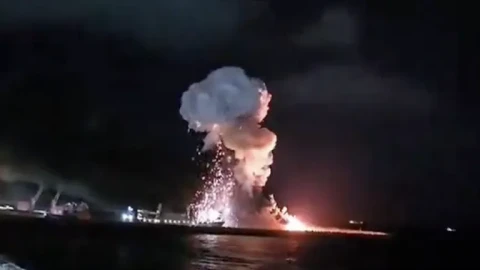
On 22 November 2026, the Russian Navy’s Steregushchiy-class corvette Merkury, which was moored at the port of Benghazi in Libya, was sunk in an attack involving unmanned surface vehicles (USVs). On the same day, the dry cargo ship MV Angara, reportedly used by Russia for military logistics, was also targeted off the coast of Benghazi. In a statement on 23 November, Ukrainian President Volodymyr Zelenskyy acknowledged Ukraine’s responsibility for the attacks. The Security Service of Ukraine (SBU) announced that seven Ukrainian-made USVs had been employed in the operation and launched from a mother ship.
Beyond an isolated military incident, the Benghazi attack constitutes a multidimensional development by virtue of its geopolitical, military, legal and economic implications. Against this background, we asked experts whether the attack on the port of Benghazi was an isolated operation or a harbinger of a broader transformation in global maritime geopolitics, examining the incident through the lenses of geopolitical competition, the transformation of naval warfare, Libya’s internal political dynamics, international law and commercial shipping.
By:
Sibel Düz, SETA
Contributors:
- Ümit Nazmi Hazır, Analyst
- Evren Mercan, National Defence University
- Cem Devrim Yaylalı, Analyst
- S. Süha Çubukçuoğlu, Trends Group
- Yücel Acer, SETA
- Gökhan Güneysu, Anadolu University
- Deniz Güler, Piri Reis University
 Ümit Nazmi Hazır
Analyst
Should the reported attacks on Russian military and commercial maritime assets at the port of Benghazi be understood as the extension of the Russia–Ukraine War into the Mediterranean, or are they part of a broader strategy targeting Russia’s global military presence and logistics networks? What implications might these attacks have for the balance of power in the Mediterranean, Russia’s regional military presence and the dynamics of escalation in the war?
Rather than viewing the Benghazi attack as the spread of the war into the Mediterranean, it would be more accurate to characterise it as a manifestation of Ukraine’s asymmetric warfare against Russia taking on a global dimension. The Russia–Ukraine War has expanded across a wider geographical area in recent months. The war had already extended into the Black Sea a long time ago. Ukraine has long conducted attacks against the Russian Navy and its maritime logistics in the Black Sea. In recent days, a state of heightened alert has also emerged in the Baltic region and Kaliningrad. The latest developments indicate that the geographical boundaries of these operations are expanding. One day before the Benghazi attack, a Russian-origin cargo ship was attacked in the Gulf of Finland in the Baltic Sea. The Benghazi attack demonstrates that Ukraine is adapting its military strategy to new geographical settings and expanding its unmanned warfare capabilities beyond the Black Sea. These attacks are very likely being carried out in coordination with the West. This can be interpreted as part of Ukraine’s and Europe’s strategy to constrain Moscow’s political and military freedom of action on a global scale. We can therefore say that the geography of the war is expanding and that the Mediterranean has become part of it. Moreover, these attacks suggest that Europe is seeking to curb Russia’s claim to great-power status and limit its global sphere of influence. While Moscow seeks to be treated as a great power at the negotiating table, developments on the ground reveal the practical limits of that aspiration.
Following the overthrow of Assad, Libya’s importance to Russia increased as Russia’s military and political presence in Syria weakened and its military bases in Syria became more constrained. Through Libya, Russia is able to manage its political and military activities in North Africa and the Sahel. The attacks on the Russian vessel in Libya are therefore intended to diminish Russia’s influence in North Africa. It is also worth recalling the following allegations: while Haftar’s forces in eastern Libya maintain close relations with Russia, there are claims that the internationally recognised government based in Tripoli has developed relations with Western countries and Ukraine at various levels. It was alleged that Libyan territory had been used in the attack on a Russian tanker in the Mediterranean in March, and that Ukrainian forces, particularly unmanned aerial vehicle (UAV) specialists, were operating in western Libya under a secret agreement approved by the West. This is turning Libya into an arena not only for the struggle between Russia and Ukraine but also for a broader international power competition. The war between Russia and Ukraine and the growing tensions between Europe and Russia point to the risk of further hardening the positions of Libya’s local political and military actors.
 Evren Mercan
National Defence University
When the experience gained from the use of unmanned surface vehicles in the Black Sea and the attack on the port of Benghazi are considered together, what transformation can be said to be taking place in conventional naval warfare? How might the ability to employ unmanned surface vehicles across different maritime theatres, particularly in the context of the concept of Narrow Seas, affect existing doctrines concerning sea control, sea denial, force protection, port and base security, and the sustainability of military logistics?
Naval operations in the Black Sea point to a profound transformation in the means and methods employed to achieve the strategic objectives of naval warfare, rather than in those objectives themselves. Without possessing a comparable conventional combat fleet, Ukraine has significantly restricted the Russian Black Sea Fleet’s operational freedom of action through the combined employment of USVs, UAVs and land-based guided missiles. This experience brings the relationship between force structure and cost in sea denial back to the forefront, while also demonstrating that superiority in conventional naval power does not guarantee operational freedom of action.
Viewed through the lens of Milan Vego’s Narrow Seas approach, the constraints imposed by geography in maritime theatres such as the Black Sea, the Baltic, the Aegean and the Persian Gulf have acquired a new dimension with the employment of USVs. In these theatres, where land and naval operations are closely intertwined, manoeuvring space is restricted, and sea lines of communication depend on critical passages and narrow straits, USVs enable the conventionally weaker party to exploit geography and create asymmetry in naval operations.
The USV attack conducted at the port of Benghazi is noteworthy in terms of the transferability of methods of warfare employed in the Black Sea to other maritime theatres. Simultaneously placing Russia’s basing and logistical support capabilities in the Black Sea, the Baltic and the Mediterranean under pressure could erode the Navy’s ability to sustain operations, with consequences extending beyond individual platform losses. Likewise, the targeting of ports in third countries may cause the political and military costs of the war to spill over beyond the theatre of conflict. This necessitates a reassessment of existing approaches to force protection, port and base defence, and the protection of maritime transportation, taking into account the continuity of logistical support.
Nevertheless, the reflex to respond to technology-induced asymmetry with technology itself can obscure the fact that warfare is a reciprocal contest of wills and intellect. At the heart of naval preparedness in peacetime should be the development of military personnel with the intellectual capacity not merely to employ existing systems skilfully, but also to comprehend the adversary’s way of thinking, challenge established assumptions and make sound decisions under conditions of uncertainty. The success of this process, which encompasses everything from military education curricula to the design of exercises, should also be measured by the ability to develop personnel capable of exercising sound situational judgement, taking the initiative and adapting to changing circumstances under unforeseen combat conditions. Its institutional counterpart is the establishment of a naval culture that encourages intellectual development and professional criticism, accurately interprets changes in the combat environment and anticipates their likely implications, develops proactive measures, and rapidly updates doctrine and operational procedures in light of lessons learned.
 Cem Devrim Yaylalı
Analyst
When the experience gained from the use of unmanned surface vehicles in the Black Sea and the attack on the port of Benghazi are considered together, what transformation can be said to be taking place in conventional naval warfare? How might the ability to employ unmanned surface vehicles across different maritime theatres, particularly in the context of the concept of Narrow Seas, affect existing doctrines concerning sea control, sea denial, force protection, port and base security, and the sustainability of military logistics?
The most significant change that unmanned surface vehicles have brought to conventional naval warfare is technological. The removal of the human element has led to the development of smaller platforms and to a blurring of the distinction between a naval vessel and a munition. Their small size and low signatures may also make these vehicles more difficult to detect and destroy. Nevertheless, it would be premature to claim that unmanned surface vehicles have altered the fundamental principles of naval warfare. The fundamental objectives and principles of naval warfare, such as sea control, sea denial, force protection, port and base security, and the sustainability of military logistics, remain unchanged. What has changed are the means and methods employed to achieve these objectives.
The history of the Mediterranean basin is replete with asymmetric attacks exploiting the element of surprise inherent in raids, similar to Ukraine’s attack on Russian vessels at the port of Benghazi. Two well-known examples immediately come to mind: in November 1940, 21 Fairey Swordfish torpedo bombers launched from the British aircraft carrier HMS Illustrious attacked Italian naval assets at the port of Taranto. In December 1941, Italian Decima MAS commandos entered the port of Alexandria using manned torpedoes and inflicted severe damage on the battleships HMS Queen Elizabeth and HMS Valiant.
These two operations illustrate several enduring characteristics of naval warfare: surprise, asymmetric attack, port security, the threat posed by submarines and special forces, and the vulnerability of large warships particularly in ports and when stationary.
The existence of unmanned surface vehicles is changing not the fundamental principles of naval warfare, but the manner in which they are applied. This change can be expected to manifest itself primarily in tactics and in practices for protecting high-value assets, whether warships or ports.
This is because these controllable munitions, which are difficult to detect and destroy, can now be encountered not only at the front or in the war zone, but even in the ports of neutral third countries far removed from the battlefield. This requires warships on active duty to maintain a constant state of readiness to counter enemy threats.
The war that began with the Russian Federation’s invasion of Ukraine has its own distinctive political, technological and operational conditions. It is therefore necessary to carefully assess whether the lessons drawn from this war can be directly applied to other ongoing or potential conflicts. Otherwise, there is a risk of generalising findings specific to a particular operational environment and drawing erroneous lessons.
 S. Süha Çubukçuoğlu
Trends Group
How can the attack on the port of Benghazi be interpreted in the context of Libya’s political divisions, the military relations between Haftar’s forces and Russia, and the struggle for influence over oil resources? Although no link has yet been confirmed between the disruption of maritime transport security in eastern Libya and interruptions to oil production and transportation routes in western Libya, what are the likely implications of these developments for Libya’s internal political dynamics, energy security and Russia’s military logistics architecture extending into Africa?
The attack targeting Russian vessels at the port of Benghazi demonstrates that the Russia–Ukraine War is becoming increasingly intertwined with the struggle for influence in the Mediterranean and Africa. Through this operation, Ukraine is signalling to Moscow that the costs of the war will not remain confined to the Black Sea and that Russia is not safe anywhere it has political and economic interests. The incident has also brought into sharp relief the risks that the confrontation between extra-regional actors such as the European Union and Russia poses to Libya’s sovereignty and fragile internal political balance.
For Russia, Libya is more than a locus of military relations with Khalifa Haftar’s forces in the east: it is a strategic transit point supporting the resupply of the Africa Corps in the Sahel. The targeting of the maritime component of this network, which comprises ports, bases and land routes, has made Moscow’s operations in Africa more costly and risky. For Haftar, the deterrent effect of Russia’s support and the attendant risk of becoming a target are rendering the balance he seeks to establish increasingly fragile. This may accelerate Haftar’s efforts to diversify his external backers and partners, but it does not mean that his relations with Russia will be severed in the short term.
Although the interruption of oil flows amounting to 350,000 barrels per day in western Libya is not directly linked to the Benghazi attack, it may be attributable to forces opposed to Libya’s unification and stability. The country’s energy infrastructure is vulnerable to pressure from armed militia groups. Control over oil production and revenues remains a key instrument in bargaining over political influence and the distribution of resources. Growing risks to maritime transportation may also increase insurance and transport costs, adversely affecting public revenues and reconstruction efforts.
For Türkiye, the priority should be to prevent this vulnerability from escalating into a renewed east–west conflict in Libya. Khalifa Haftar’s visit to Ankara on 24 November and President Recep Tayyip Erdoğan’s forthcoming visit to Tripoli on 8–9 December for the Türkiye–Africa Cooperation Summit demonstrate that Ankara is developing its relations with Benghazi while maintaining its cooperation with Tripoli. Türkiye’s dialogue with both sides may facilitate consensus on the unification of security institutions under a single framework, the security of energy infrastructure and the distribution of oil revenues. The coordination already established with Egypt will further strengthen the regional foundations of this process. As the rapprochement between Türkiye, Egypt and Libya has continued, Cairo has maintained its relations with Libyan Prime Minister Dbeibah and has not opposed Ankara’s dialogue with the Haftar family. This approach has been informed by the assessment that a reduction in security risks in eastern Libya could also present Egypt with commercial and economic opportunities. Consequently, addressing political integration, energy supply and maritime security as interconnected processes is important if the diplomatic gains of Türkiye’s Libya policy are to translate into long-term cooperation.
 Yücel Acer
SETA
What issues do the use of unmanned surface vehicles within the sovereign jurisdiction of third countries and the potential use of commercial shipping activities for covert military operations raise under the international law of the sea and the law of neutrality? To what extent is the legal distinction established by the Montreux Convention Regarding the Regime of the Straits between military and commercial passage adequate in the face of new-generation unmanned warfare technologies? What approach should Türkiye adopt in terms of its legal, diplomatic and security policies in response to these developments?
On 22 November 2026, Ukrainian unmanned surface vehicles (USVs) launched an attack against the Russian warship Merkury, which was at the port of Benghazi in Libya, and it was announced that the vessel had been sunk. Ukrainian President Volodymyr Zelenskyy confirmed that the attack had been carried out by Ukrainian forces; he also stated that the cargo ship MV Angara, reportedly used by Russia to transport weapons, had been targeted. The Ukrainian government stated that it regarded the attack as falling within the scope of its right of self-defence against Russia’s armed attack on Ukraine.
Ukraine’s claim that it conducted this attack in self-defence must be assessed in terms of whether the Russian vessel constituted a military objective and whether the attack met the requirements of necessity and proportionality. Under the law of naval warfare, warships belonging to states that are parties to an armed conflict constitute military objectives. Nevertheless, compliance with the principles of distinction, proportionality and precautions in attack is mandatory. Commercial vessels, by contrast, may be targeted only if they make an effective contribution to military operations and their destruction offers a concrete military advantage.
An important legal aspect of the incident, however, is that the attack took place within Libya’s sovereign jurisdiction, at the port of Benghazi. Conducting a military operation on the territory of a third state without Libya’s consent or another legal justification recognised under international law may raise the question of a violation of Libya’s sovereignty under Article 2(4) of the UN Charter. The lawfulness of the attack must therefore be assessed not solely by reference to whether the Russian vessel constituted a military objective, but also by taking into account the geographical location of the operation and Libya’s sovereign rights.
Another important issue concerns responsibility. In this instance, Ukraine acknowledged that the unmanned surface vehicle was its own and stated that it had conducted the attack, thereby clarifying the question of responsibility. Often, however, this is not the case, and difficulties may arise in determining who should be held responsible for the damage inflicted and for any offence committed.
For Türkiye, the issue that merits particular attention is the difficulties that may arise in applying the Montreux Convention Regarding the Regime of the Straits to contemporary circumstances. From the standpoint of international law, and in this context that of the Montreux Convention, the scope of the concept of a warship is once again open to debate, raising the question of whether small but armed military unmanned surface vehicles should be classified as warships. These issues are of considerable significance for the application of the restrictions imposed by the Montreux Convention on the passage of warships through the Turkish Straits in times of “peace”, “imminent danger of war” and “war”. Türkiye needs to define its own approach to this issue and support the processes through which general approaches are developed.
 Gökhan Güneysu
Anadolu University
What issues do the use of unmanned surface vehicles within the sovereign jurisdiction of third countries and the potential use of commercial shipping activities for covert military operations raise under the international law of the sea and the law of neutrality? To what extent is the legal distinction established by the Montreux Convention Regarding the Regime of the Straits between military and commercial passage adequate in the face of new-generation unmanned warfare technologies? What approach should Türkiye adopt in terms of its legal, diplomatic and security policies in response to these developments?
We observe technological progress with great admiration. Yet, by its very nature, the law can barely keep pace with technology and invariably does so after a certain time lag. The international law of the sea is no exception in this regard. Autonomous platforms are vehicles that do not fit the conventional classifications in this field, yet are frequently used in peacetime and, particularly, in wartime. Should these novel vehicles be employed in warfare, the existing rules of the law of armed conflict (LOAC) will undoubtedly apply. It must be emphasised here that the rules and principles of LOAC do not vary according to the weapon employed.
Every rule of the law of naval warfare governing the conduct of hostilities must be applied in full today. It is an important principle that civilian objects and civilians must not be made the direct object of attack. Likewise, even certain vessels that may lawfully be targeted must not be subjected to the reckless use of violence without consideration of human casualties. Care must also be taken in selecting the location of an attack to ensure that neutral states are not affected by hostilities. Similarly, it is imperative that attacks not be conducted in the maritime territory of neutral states. Under Article 2 of the 1907 Convention concerning the Rights and Duties of Neutral Powers in Naval War, “Any act of hostility, including capture and the exercise of the right of search, committed by belligerent war-ships in the territorial waters of a neutral Power, constitutes a violation of neutrality and is strictly forbidden.”
Pursuant to Article 31 of the Vienna Convention on the Law of Treaties, international treaties are interpreted in good faith, in the context of the treaty as a whole and in the light of its object and purpose. It should be stated plainly that the Montreux Convention Regarding the Regime of the Straits, understood in the context of the historical process that began with Lausanne, prioritises the security of Türkiye and its neighbours (the text reads: “within the framework of the security of Turkey and of the security, in the Black Sea, of the riparian States”) and seeks to establish Türkiye’s control through certain restrictions.
This framework and the historical concerns prevailing at the time should inform the interpretative process necessary when applying the Montreux Convention to contemporary events. It will therefore be possible to determine the regime to which evolving and emerging maritime vehicles should be subject through an interpretation consistent with both the letter and the spirit of the Montreux Convention. What matters here is the ability to embrace the original underlying approaches that prioritised the security of Türkiye and its neighbours. Given that, in today’s political context, the alternative to Montreux would very likely be a regime akin to transit passage, considerable caution must be exercised with respect to Montreux, and the provisions embodied in the Convention must be applied with persistence and seriousness. It would, of course, be appropriate to subject new types of vessels and other systems arising from contemporary technological developments to the existing classifications under the Montreux Convention. This is also the prudent course from the standpoint of legal policy. The decisive factors here are the function and capabilities of every type of modern system. Depending on these capabilities and functions, the maritime vehicles in question, some of which are autonomous, may be classified as warships or submarines.
At precisely this point, an objection may arise that autonomous maritime vehicles do not conform to the definition of a warship contained in the United Nations Convention on the Law of the Sea (UNCLOS). We know that an autonomous maritime vehicle navigates using pre-programmed algorithms and artificial intelligence. Nevertheless, following prior military planning, these systems are activated by a member of the armed forces and subsequently monitored by the same personnel. It may be argued that the officer/non-commissioned officer control provided for in UNCLOS is ensured for most systems. Should this interpretation be adopted, the relevant restrictions under the Montreux Convention pertaining to warships and the like must apply.
It has been argued, however, that fully autonomous underwater vehicles (armed but unmanned) do not qualify as ships. If such an approach is adopted, it may also be reasonable to regard systems of this nature as weapons or instruments of warfare. This means that it would also be legally correct to treat the passage through the Turkish Straits of a loitering autonomous maritime system or one directed towards a specific target as equivalent to the firing of a gun from a ship. In such a case, this passage may be regarded as an act with the potential to cause harm and to threaten the security of the Republic of Türkiye.
The Republic of Türkiye is a responsible state that must coexist with its neighbours and has repeatedly expressed its intention to develop relations with them based on the principles of equality and peace. On this basis, Türkiye, which formulates its policies with due priority to its own prosperity and security, must above all proceed with caution. Efforts to ensure that its citizens and, of course, its merchant fleet are not harmed are among its priorities. Likewise, regarding the Turkish Straits, it must be well understood by the international community that there will be no retreat from the Montreux Convention. The reason is that the alternative would be a passage regime that places considerably greater restrictions on our sovereignty.
 Deniz Güler
Piri Reis University
How might the potential use of merchant vessels in covert military operations affect the traditional distinction between military and civilian shipping? If such methods become widespread, what systemic consequences might arise for international commercial navigation, marine insurance, ship ownership and operational arrangements, the responsibilities of flag and port states, and international security regulations such as the ISPS Code? To what extent is the existing global maritime security architecture prepared to address these threats?
The use of merchant vessels in covert military operations would make it extremely difficult in practice to uphold the distinction between civilian and military objectives, which constitutes the foundation of the law of armed conflict at sea. The use of a merchant vessel as a direct attack platform or as a platform facilitating an attack may readily cause it to acquire the status of a military objective. The principal danger posed by the proliferation of this method is that the use of even a few more merchant vessels as USV carriers in military activities in this manner could undermine international confidence in the civilian character of thousands of merchant vessels.
With the proliferation of the shadow fleet phenomenon as a form of anti-system activity, states had already stepped up practices such as stopping, searching and diverting vessels to port, seizing and confiscating them, or subjecting them to more extensive security inspections in ports. This had generated momentum towards the further securitisation of international commercial navigation. Indeed, across a vast geographical expanse extending from the Baltic Sea to the North Sea, and from the Caribbean to the Mediterranean, the Black Sea and the Arabian Sea, intervention against merchant vessels at sea and boarding them for inspection had become practices that actors have sought to legitimise on various legal and security grounds.
The onset of a second process of securitisation, which would also call into question the civilian character of merchant vessels, would expand the scope and intensity of existing inspection and control practices, leading to delays and higher transaction costs in international maritime trade. In this context, marine insurers and the reinsurance market would have to deepen their risk assessments across a chain of connections ranging from the geographical areas in which merchant vessels operate to their ownership and operational arrangements. Rising war-risk premiums, the narrowing of insurance coverage and the withdrawal of coverage in certain geographical areas erode the inherent structural cost advantage of maritime transport.
Today, the owner, operator, charterer, insurer, port of call, cargo, flag state and crew of a merchant vessel may all be associated with different countries. Determining which of these actors had knowledge of a covert military operation, acted with intent, or bore responsibility for it will become a significant legal, commercial and geopolitical issue. Countries that are not parties to the war and commercial entities may find themselves embroiled in entirely unforeseen legal, economic and diplomatic disputes. The responsibilities of flag states in overseeing the activities of vessels registered under their own flags will assume greater significance. Port states, in turn, will require intelligence and inspection capabilities that enable them to assess the true nature of commercial activities, going beyond verification of the compliance of ship security documentation.
The International Ship and Port Facility Security (ISPS) Code, developed in the aftermath of the 11 September attacks and brought into force in 2004, provides a limited but critical institutional framework for preventing security threats to ships and port facilities. At a time when tensions are increasingly accumulating within the world-system, international intelligence sharing will need to be enhanced, ship ownership and operational arrangements made more transparent, and security inspections and controls adapted in light of emerging threats. The challenge, however, is to implement all these security measures without undermining the freedom of international commercial navigation, which appears scarcely feasible.