
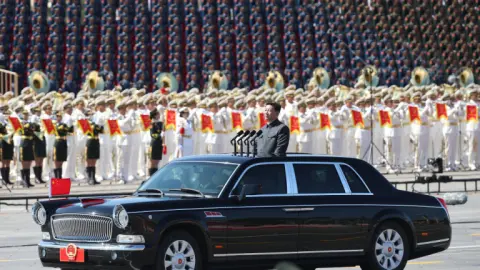
China's Victory Day celebrations commemorating World War II took place in a grand style on September 3, 2025. Amid tensions with the US, the event showcased China's political and military strength. Although China's rhetoric of "multilateralism" was expressed, it became apparent that the bipolar era had effectively resumed, with China positioned as the leader of the opposing side.
Taking an X-ray of the Victory Day celebrations at this point will help in understanding the direction of the strategic shift. It is also important to note that the Chinese show of force coincided with Israel's actions in Gaza, Yemen, Iran, Syria, and Qatar; the tension between the US and Venezuela; and perceptions of the Russian threat in Eastern Europe. In this context, it is first necessary to briefly define China.
China, with a population of 1.409 billion at the end of 2023, is the country with the second-largest population after India. The literacy rate is 96.8% (99% among young and middle-aged people), and there are roughly 240 million university graduates. The number of people of military age, between 18 and 22 years old, is about 70-75 million. Additionally, the number of people aged 20 to 44 who can be mobilized is 475 million. In other words, China does not face a shortage of skilled human resources or a lack of people available for mobilization. It has more than the population of the United States, which accounts for one-third of China’s population. In the event of war, China is the only country that will not experience a shortage of skilled human resources.
China's economic data is impressive. As of late 2023, its nominal GDP stands at $18.56 trillion, with a purchasing power parity of $33.01 trillion. Its external debt is quite small at $2.54 trillion. The People's Bank of China's net reserves, including dollars and gold, amount to $5.14 trillion, making it third in the world behind the US and Japan. China, which has a trade surplus of around $1 trillion annually, spent $318 billion on the military by the end of 2024.
The US, meanwhile, with its $38 trillion debt stock and annual trade deficit of $1.2 trillion, is reminiscent of the Titanic scenario. As a result, in the strategic competition against the US, China possesses the economic power to form a new pole.
On its Victory Day, China staged an impressive display of power, highlighting its social unity, economic strength, and political cohesion. To understand this trend, one must "see" the ceremony from start to finish.
The welcoming ceremony saw participation from heads of state from countries with strong military, political, and economic ties to China. In this context, alongside Russia, North Korea, Belarus, and Iran—who have issues with the US and the West—the Presidents of Serbia, Armenia, Azerbaijan, Pakistan, Indonesia, Vietnam, Cambodia, and the Central Asian Turkic Republics attended the event. Xi's special attention to Putin and North Korean leader Un did not go unnoticed. At this point, signs were given of a new world order defined by "solidarity" rather than alliance, shaped around China.
Following the photo session, Xi delivered a five-minute speech. In his speech, Xi clearly articulated the traditional argument of "Japanese aggression," reiterating his hope for "shared security, eliminating the root causes of war, and preventing the recurrence of historical tragedies." However, he did not hesitate to make indirect references to the West, led by the US, emphasizing that "humanity is again forced to choose between peace and war, dialogue and conflict, win-win cooperation and zero-sum games."
In the third part of his speech, addressing the Chinese people, Xi stated within the ideological framework that "under the strong leadership of the CPC; we must follow Marxism-Leninism, Mao Zedong Thought, Deng Xiaoping Theory, the Three Represents, and the Scientific Outlook on Development, and fully implement the Thought on Socialism with Chinese Characteristics for a New Era."
While delivering clear messages about the spirit of unity among the Chinese people, he used the phrase "all ethnic groups of the Chinese people." At this point, it can be said that he was addressing the entire Chinese community of Chinese origin living outside China (Southeast Asia, Indonesia, Malaysia, Australia).
During the parade, new Chinese weapons were showcased. These weapons seem to include advanced systems that combine technology and artificial intelligence. Robotic and unmanned systems, smart ammunition, and hypersonic missiles were emphasized. Chinese soldiers, both men and women, demonstrated discipline through robotic parade rituals. However, it is important to assess the military aspect of this ceremony.
First and foremost, the weapons attracted attention not only for their defensive capabilities but also for their offensive features. When the DF-5C series missiles were shown to the public, it was evident that they could strike the U.S. with 10 warheads capable of carrying nuclear payloads. Among the weapons and ammunition on display, the YJ-20 anti-ship missiles, designed specifically to counter maritime threats, received special emphasis. This indicated that countermeasures had been developed against U.S. aircraft carriers in the context of Taiwan-related tensions.
Meanwhile, it was suggested that HQ-29 missiles might also target satellite infrastructure in space. Additionally, smart munitions capable of carrying nuclear warheads from Air Force missiles were noteworthy. Another system that received little media attention was China's electronic warfare tools. It was also noted that China has equipped all its military vehicles with chemical, biological, nuclear, and radiological protection capabilities.
The main military takeaway from the Victory Day celebrations relates to the defense industry. China now has an infrastructure capable of challenging the EU and the US in arms exports. Countries facing issues with the West can import defense products without political strings attached and at low costs. This will foster political, economic, and military loyalty and dependence on China. Naturally, countries in the global south that feel they have been "wronged" may become supporters of China's movement to become regional powers. When combined with its economic strength, China could take the lead in the global south.
From the view of international politics, a new phase has started that could discourage the US regarding China's actions on the South China Sea, the Indo-Pacific, and Taiwan. Depending on China's military movements, either a new 'balance of power' or a new era with China as the leading hegemon might begin between the US and China. The political chaos inside the US and its conflicting stance based on tariff and sanction threats will influence China's worth in the international system. It's uncertain whether the global south, which might fall for the 'allure of the powerful', along with Russia, Iran, North Korea, and (possibly) India, will band together into a firm alliance. Still, it must be recognized that this possibility exists because of the US's aggressive policies.
At this point, it is important to consider China's ability to set norms in addition to its economic and military strength. China, which unites developing countries and the Global South under the banners of BRICS and the Shanghai Cooperation Organization, could influence the norms of international politics, potentially leading to the creation of a "multilateral" or "bipolar" system.
In conclusion, China, with its combined economic, social, and military strength, is now a de facto superpower! However, China's proactive stance and options for direct intervention have not yet been fully utilized in global security and welfare issues. If China mobilizes its military and economic resources to address international and regional security concerns, a new 'superpower' will emerge.
[Anadolu Agency, September 16, 2025]
