
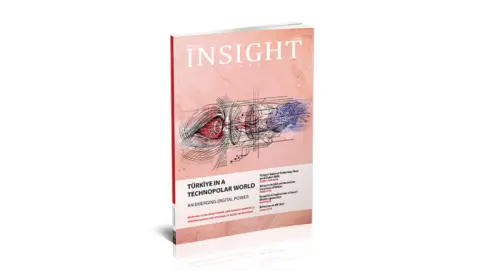
We are pleased to announce the publication of the latest issue of Insight Turkey, dedicated to one of the most critical transformations of our era: the emergence of a technopolar world order. As power in the international system increasingly shifts from traditional military and economic dominance to technological supremacy, this issue delves into the multifaceted political, economic, and security implications of this global shift.
This special issue explores how emerging technologies, such as artificial intelligence, quantum computing, cybersecurity, and digital platforms, are reshaping state power, sovereignty, and global competition. Türkiye’s proactive approach to this transformation is examined in depth, highlighting national initiatives in defense technology, AI development, digital sovereignty, and innovation ecosystems.
This special issue opens with insightful commentaries by Türkiye’s Minister of Industry and Technology, Mehmet Fatih Kacır, and TÜBİTAK President, Orhan Aydın. Kacır frames the National Technology Move as Türkiye’s strategic response to global shifts in industry and geopolitics, positioning the country as a trusted and innovative actor. Aydın outlines TÜBİTAK’s leadership in high-tech production and key milestones such as the national supercomputer, a Turkish Large Language Model, and the launch of TÜRKSAT 6A.
The issue expands beyond Türkiye to address global technological dynamics, particularly within the context of U.S.-China competition. Chuanying Lu examines the institutionalization of digital geopolitics, raising critical questions about a potential tech Cold War. Liu Guozhu offers an in-depth analysis of China’s innovation ecosystem, highlighting its coordinated structure across sectors. Dolapo Fakuade explores the double-edged role of AI in intercultural communication, warning against unregulated adoption. Katherine Chandler discusses data’s pivotal role in AI and warfare, arguing that data, unlike physical resources, must be critically assessed in conflict zones. Anicia Peters reflects on the 2025 Antalya Diplomacy Forum, emphasizing Türkiye’s diplomatic leadership and Africa’s technological challenges.
Erman Akıllı and Gloria Shkurti Özdemir analyze Türkiye’s strategic pursuit of technological sovereignty, while Kamil Tarhan examines the country’s evolving cybersecurity policies and AI integration. Fatih Sinan Esen details Türkiye’s AI strategy, emphasizing human capital, regulatory adaptation, and national competitiveness. Gökhan Bozbaş illustrates Türkiye’s integration of defense technologies into agriculture to enhance sustainability and resilience. Itır Toksöz delves into the concept of technopolarity in the context of Türkiye’s space program, contrasting global models of tech power. Ahmet Özkan and Meysune Yaşar analyze Türkiye’s naval modernization through offense-defense theory and technological capability. Ozan Ahmet Çetin and Abdullah Keşvelioğlu compares Türkiye and the UAE’s military AI priorities, showing how national needs shape adoption. Cenay Babaoğlu and Ecem Buse Sevinç Çubuk explore AI’s dual role in global governance, positioning Türkiye as a regional mediator. Nezir Akyeşilmen and Yavuz Akdağ propose a recalibrated IGF to enhance legitimacy and inclusivity in digital governance. Helder Ferreira do Vale evaluates AI regulatory readiness across BRICS countries, finding sharp contrasts in implementation and strategy. Mustafa Böyük compares ideological tendencies in Eastern and Western AI models through ChatGPT-4 and DeepSeek-R1, revealing deep-seated algorithmic biases and their implications for global digital norms. Mehmet Emin Erendor and Emre Çıtak explore the impact of autonomous weapons and killer drones on modern warfare.
Finally, Hakkı Uygur’s off-topic commentary analyzes the changing geopolitical impacts following Israel’s simultaneous air, cyber, and covert attack on Iran on June 13, 2025.
Contributions in this volume provide diverse perspectives on how Türkiye navigates the strategic challenges and opportunities of the technopolar age. From cybersecurity and AI strategy to military innovation and space technology, the articles offer an essential guide to understanding how middle powers like Türkiye can become influential actors in the emerging global technological order.
With expert analyses from leading scholars and a special commentary by Türkiye’s Minister of Industry and Technology, this issue is a must-read for policymakers, academics, and readers interested in the intersection of technology and international affairs.