
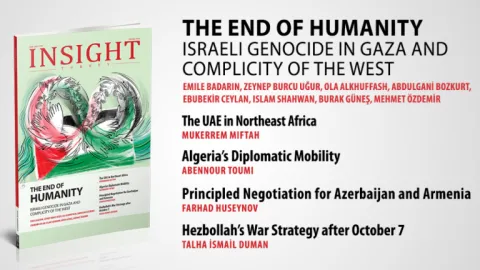
We are pleased to announce the latest issue of Insight Turkey, dedicated to the Israeli genocide in Gaza and the complicity of the West. This edition features compelling commentaries and research articles addressing one of the most urgent humanitarian and geopolitical crises of our time.
This issue starts with Emile Badarin, he critiques recent recognitions of Palestinian statehood as symbolic gestures lacking real protection and sovereignty. In the research articles section, Zeynep Burcu Uğur, Ola Alkhuffash, and Islam Shahwan present survey results from 1,188 Gazans, challenging simplified assumptions about public opinion under siege. Abdulgani Bozkurt and Muharrem Doğan examine Israel’s use of sacred narratives to justify violence, while Yakup Yıldırım and Burak Güneş, in their respective articles, analyze the South Africa v. Israel genocide case, highlighting both the potential and limits of international law.
The issue also focuses on Western institutions and media. Ebubekir Ceylan explores the restriction of academic freedom in the UK through politicization and misuse of anti-Semitism, and Mehmet Özdemir analyzes Thomson Reuters’ coverage, showing how Western media often reinforces Israel-centered narratives. Muhammed Hüseyin Mercan and Yusuf Ziya Gökçek decode Israeli popular culture’s role in normalizing violence, through movies. While Erhan Bektaş traces Ottoman-era land transfers shaping early Zionist settlement from historical perspective, Talha İsmail Duman examines Hezbollah’s strategy through Ontological Security Theory through security perspective. Gökhan Çınkara analyzes Türkiye’s shifting foreign policy Dynamics with Israel after Al-Aqsa Flood.
This issue also features off-topic but relevant works. Mukerrem Miftah examines the UAE’s growing influence in Africa, and Abdennour Toumi analyzes Algeria’s renewed foreign policy ambitions. Farhad Huseynov applies negotiation theory to peace prospects in the South Caucasus. Additionally, Orkhan Valiyev situates Türkiye’s domestic transformation in a multipolar global context, and Ahmet Faruk Levent and Hatice Gül study how assimilation policies threaten diasporic cultural continuity.
We hope this issue provides valuable insights for scholars, policymakers, and readers seeking a deeper understanding of this critical period in global politics.