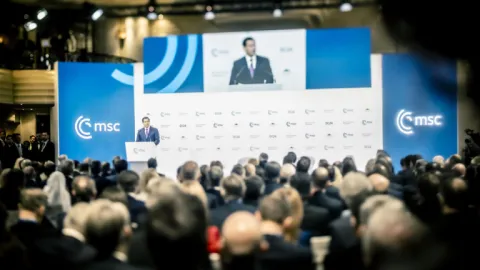
The Munich Security Conference (MSC), the world's most comprehensive defense and diplomacy platform which takes the pulse of the global security architecture and brings together the decision-makers of the international system, from state leaders to defense industry giants, convened for the 62nd time this year. The summit took place in a climate of profound uncertainty as it hosted some key protagonists of global competition such as U.S. Secretary of State Marco Rubio, Chinese Foreign Minister Wang Yi, and the host, German Chancellor Friedrich Merz. This year’s official theme of "under destruction," accurately summarized the current global order and served to certify the structural collapse of the architecture established after World War II.
As indicated by the pre-conference report and recent public opinion polls, nearly 70% of the European public now believes their national security is under direct threat. This profound sense of insecurity also defined the contours of the sessions in Munich. Indeed, almost all participants, particularly the Westerners speaking at the summit, implicitly or explicitly acknowledged that the "rules-based international order," which they have worked on and defended for more than a century, has effectively ended, and that the brief unipolar hegemony experienced after the Cold War has permanently closed. When evaluated alongside similar rhetoric recently expressed in Davos, this situation proves that the West is moving away from its claim of building a universal global order, transitioning instead to a much more defensive and inward-looking geopolitical phase that centers on its own security.
However, this does not mean that the system is dragging toward total annihilation; on the contrary, the West is carrying out the turbulent construction of a new hegemonic consensus to manage this "age of normlessness" by overcoming the Transatlantic crisis.
The Transatlantic Crisis: The End of the Comfort Zone
Munich has become the summit where the fractures along the Transatlantic fault line can be observed most clearly. As will be remembered, during his speech at the conference exactly a year ago, U.S. Vice President JD Vance sent a chill through the hall by stating that the greatest threat to Europeans actually originated from within themselves. Over the past year, it was understood that these words were not mere rhetoric. The calls directed at Europe in the National Security Strategy Document, the customs tariffs brought to the table against Europe, and even the annexation rhetoric aimed at Greenland, which is within Denmark's sovereign territory, have forced a rapid and pragmatic awakening in European capitals.
The issue of Europe's insufficient contribution to the NATO budget which has been one of Trump's biggest points of criticisms since assuming office, also became one of the re-evaluated matters. The fact that Europe has built welfare states by cutting military budgets for decades and outsourced its security bill to Washington has begun to be defined as an illusion by European leaders themselves. The following self-criticism by German Defense Minister Boris Pistorius stands as the most striking proof of this awakening: "We got used to the strong support from the U.S. We got used to our comfort zone in which we used to live. This time is over, definitely over. Washington was right." Similarly, European Commission President Ursula von der Leyen summarized the gravity of the situation with these words: "Some red lines have been crossed that can no longer be reversed. But at least we all agree on what is needed and we are implementing it."
Within this equation, and at a time when Europe is demonstrating an effort to understand the fundamental complaints of the U.S., Washington has already shifted its strategic vision away from the EU toward the Indo-Pacific. The messages delivered by U.S. Deputy Assistant Secretary of Defense Elbridge Colby, at the NATO defense ministers' meeting in Brussels right before the conference, confirmed that Europe is now a secondary front: "Under President Trump's leadership, we are reprioritizing the defense of our homeland and the protection of our interests in our Hemisphere." Colby’s NATO 3.0 vision, which calls on Europe to cease being a dependent subcontractor to the U.S. and become a true partner carrying its own weight, reflects Washington's new and realistic strategic mindset.
Economic Statecraft, Transactionalism, and the Retreat of Soft Politics
One of the most strategic ruptures certified by the conference is the definitive abandonment of values-based politics in the international system, pivoting toward a strictly transactional ground. The liberal belief that a rules-based free market economy and interdependence would ensure global peace has given way to the ruthless reality of geopolitical competition, a situation corroborated in the conference speeches. Global trade is no longer a natural and neutral instrument for increasing prosperity. It has transformed into the sharpest front of the economic statecraft doctrine, where tariffs, technology embargoes, supply chain restrictions, and unilateral sanctions are utilized as weapons. States are restructuring their economic engagements not on the basis of democratic ideals or common norms, but rather through a purely pragmatic cost-benefit calculus aimed at breaking strategic dependencies and minimizing geopolitical risks.
This new ground, where hard power elements and economic nationalism take center stage, has also fundamentally shaken the hierarchy of priorities in international diplomacy. "Soft politics" issues such as climate change and security, combating global poverty, or human rights – which were the prominent showcase topics of the Munich Security Conference in past years – occupied a minimal space on the official agenda this year. Similarly, it was observed that these issues were minimally discussed in the speeches and rhetoric echoing from the conference.
In this age of normlessness great powers act predominantly out of security concerns, and where military deterrence, new alliance relations, regional ownership, and the arms race have once again become the main agenda items. As a result, resolving crises concerning the global commons is now seen as a luxury and occupies a minimal place on the agenda of global summits. The marginalization of these topics is the clearest indication that the West has either given up on telling a universal and normative story that embraces the entire world or lacks the energy to do so. Instead, it has retreated to a rigid and exclusionary transactionalism focused on strengthening its own geopolitical fortress.
Pragmatic and ‘Ad-Hoc’ Quests
Faced with this new and harsh reality of "economic statecraft," the system is witnessing regional fragmentation rather than a sudden collapse. Deprived of Washington's umbrella in this new equation, European countries have bitterly realized that their massive economic size (a GDP of approximately $20 trillion) does not automatically translate into military and political deterrence. Indeed, this realization and the new quests it brings along were also reflected in the main sessions of the conference.
This capacity problem is steering European and Western actors away from the ossified bloc politics of the Cold War era, directing them toward pragmatic, flexible, and ad-hoc alliances that respond to immediate crises. In the new era, Europe is striving to deepen its commercial integration with India. Simultaneously, to counterbalance Chinese influence in the Asia-Pacific, the U.S. is building flexible coalitions on conjunctural and specific issues (such as semiconductors and maritime security) with countries like Japan, South Korea, and Australia through the Pax Silica program. As evidenced by the discussions at the conference, during this transition period, ideological unity is being replaced by a pragmatic balancing politics where each file is evaluated on its own merits.
The Return of the Civilizational Axis
The most critical moment deciphering the mental codes of the Munich Summit was undoubtedly U.S. Secretary of State Marco Rubio’s speech. Shelving liberal concepts such as human rights or the export of democracy, which have served as the showcase of American foreign policy for decades, Rubio repeatedly emphasized "civilization" throughout his remarks. The civilization Rubio pointed to was the expansionist, white, Christian civilization that forged Transatlantic ties. The applause from the European elites in the hall for this exclusionary rhetoric – which advocated for the revival of the "great Western civilization" by invoking the legacy of lost Western empires – can be interpreted as the awakening of a historical reflex.
However, an important caveat is in order here. While it is evident that civilizational rhetoric has made a political comeback in U.S. policymaking, Washington is also attempting to balance this discourse through varying statements and actions. It should be noted that Rubio’s deliberately provocative speech – essentially a wake-up call to Europe – was also heavily tailored for a domestic voter base.
By contrast, U.S. Deputy Assistant Secretary of Defense for Strategy Elbridge Colby, projected a more statesmanlike profile at the same conference. He called for the reconfiguration of U.S.-European relations in a noticeably more measured tone. Rejecting the premise of alliances built on liberal norms, Colby formulated the spirit of this new era around "common sense and flexible realism." In doing so, Colby effectively declared that the U.S. now expects geopolitical cost-benefit calculations from its allies, rather than ideological loyalty.
The Global South Dilemma and Türkiye’s Position
As the West becomes increasingly consumed by internal debates, European rhetoric that the international order can be salvaged by integrating the Global South, fails to reflect realities on the ground and faces significant push-back. The inequitable representation within institutions like the International Monetary Fund (IMF) – a cornerstone of the contested international system – serves as the most concrete illustration of this discrepancy.
While Europe accounts for less than one-fifth of global economic output, it retains over a quarter of the decision-making power at the IMF. In contrast, the voting weight of an economic powerhouse like China is restricted to merely a quarter of Europe's share. The fact that the top leadership of these institutions has remained closed to non-Europeans for nearly a century perfectly encapsulates the exclusionary nature of the system. This institutional injustice, coupled with the West's reluctance to relinquish its decision-making monopoly, thoroughly erodes the Global South's confidence in the existing order.
For Türkiye and the Global South – both of which have long advocated for a comprehensive overhaul of the international order – the Munich Security Conference served as a concrete validation of their enduring systemic critiques. In this emerging “age of global normlessness,” where the system is being dismantled by its very architects and the instinct for “self-help” has become the primary driver of international relations, the historical vindication of Türkiye's long-term investment in “strategic autonomy” is now indisputable. In this new equation, as the Western alliance becomes mired in its own ontological crises and the reliability of external security umbrellas is increasingly called into question, Ankara's push for indigenization of its defense industry, its practice of multi-axial diplomacy, and capacity to project hard power when necessary have ceased to be mere ideological preferences. Rather, they have transformed into rational and vital reflexes of statecraft.
President Recep Tayyip Erdoğan’s strategic warning, which perfectly coincided with the debates surrounding the Munich process – stating, “I hope everyone has now understood that a viable European security equation cannot be established without Türkiye. We have been explaining the multidimensional positive contributions our country can offer the EU. The time has long come to integrate Türkiye into Europe's defense and security mechanisms' – clearly delineates Türkiye's strategic center of gravity in this new era. Rather than a mere plea for European integration, this statement is a proposal for a security architecture grounded in geopolitical realities.
At a juncture where the United States has reduced its security guarantees to a transactional cost-benefit calculus, and Europe suffers from a severe capacity deficit in defending its own geopolitical borders, any European security design that excludes Türkiye lacks viability on the ground. Türkiye not only commands massive military capabilities but also serves as a critical filter against asymmetric shocks – ranging from terrorism to irregular migration – that could otherwise destabilize the continent. Consequently, in this chaotic transitional phase where the West has turned inward, Türkiye is not merely consolidating its own autonomy; it simultaneously acts as an indispensable linchpin, sustaining the continent's security reality against Europe's strategic blindness.
Ultimately, the 62nd Munich Security Conference served as the podium from which the obituary of the old world was read. Yet, this collapse does not represent a doomsday scenario for Türkiye and the Global South. Rather, it constitutes a window of opportunity where the long-advocated thesis that “The World is Bigger than Five” translates into actionable reality. In this transitional phase where the rules of the game are being actively rewritten, Türkiye – relying on its own hard power capabilities, astutely reading the realities of transactional politics, and deepening its multidimensional ad-hoc diplomacy – will continue to operate as a critical playmaker. At the negotiating table of the emerging new order, Ankara will undoubtedly cement its status not as a mere object, but as an undisputed subject.