
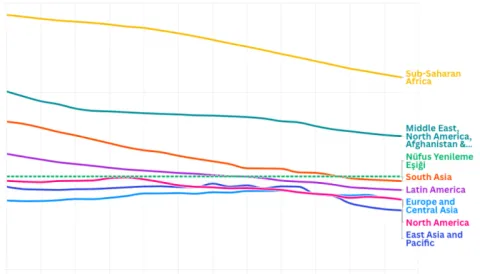
Global Demographic Trends: Declining Fertility Rates
The world has undergone a profound demographic transformation over the last twenty-five years. In many regions, birth rates have plummeted to historic lows. Data from the World Bank illustrates the scale of change. Currently, Sub-Saharan Africa remains the only outlier maintaining a high-fertility structure with a rate of 4.33. In contrast, Latin America, North America, Europe, East Asia, and South Asia have all seen their total fertility rates (TFR) fall below the replacement threshold of 2.1 children per woman.
Fertility Rates of Selected Countries (2000 - 2023)
This demographic transition is particularly striking across Turkey and its neighboring regions. In the Balkans and the Caucasus, countries such as Bulgaria (1.81) and Armenia (1.90) continue to operate well below the replacement level as of 2023. Azerbaijan has witnessed a significant decline, with its rate dropping from 2.0 in 2000 to 1.55 in 2023. Turkey, however, has experienced one of the most drastic transformations in the region; its fertility rate fell from 2.48 in 2000 to 1.51 in 2023, evolving into a demographic structure mirrored by much of Europe. While Middle Eastern nations like Iraq (3.24) and Syria (2.71) still maintain relatively higher rates, they have moved significantly away from their levels of over 4.0 recorded at the turn of the millennium. The consistent downward trend in these countries underscores the regional ubiquity of this shift.
While declining birth rates represent a global trend, Israel stands as a notable exception, maintaining a remarkably stable fertility rate of approximately 3% for over three decades. This anomaly, given its implications for labor markets, economic growth, and social fabric, is largely attributed to a combination of deeply rooted religious and cultural norms supported by extensive state incentives. Interestingly, while similar outcomes might be expected in Muslim-majority countries where cultures and traditions encourage large families, the data in Figure 3 suggests otherwise. Many Muslim nations are, in fact, following the broader global trend of demographic contraction.
Fertility Trends in Certain Islamic Countries
This demographic landscape is not merely a social evolution; it is a pressing economic challenge. When the total fertility rate falls below the replacement level of 2.1, it inevitably leads to a shrinking labor supply and weakens the capacity of the working-age population to sustain social security systems for the elderly. The decline observed between 2000 and 2023 indicates that many countries are rapidly exhausting their “demographic window of opportunity,” the period during which a youthful population drives accelerated economic growth. For economies like Turkey, where the rate has dipped to 1.51, the diminishing productive population poses a dual threat: a projected slowdown in economic growth and an escalating fiscal strain on social safety nets.