
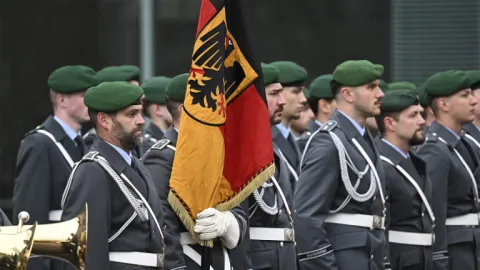
Germany’s release of its first ever military strategy marks a significant change in its post-Cold War security trajectory. Four years after then Chancellor Olaf Scholz made the Zeitenwende declaration in 2022, and 3 years after the publication of the National Security Strategy in 2023, the document reflects Berlin’s attempt to translate political intent into a coherent military framework. It emerges in a rapidly deteriorating security environment defined a rise of interstate war’s both globally and in Europe, intensifying great power competition, and growing uncertainty about the role and commitment of the United States in European defense architecture.
In line with the NATO Strategic Concept, the National Security Strategy, and most other European nations, the new military strategy positions Russia as the primary and enduring threat to European security and calls for a fundamental reorientation of the Bundeswehr towards high-intensity collective defense. It also articulates an ambitious objective: transforming Germany into the strongest conventional armed force in Europe. However, while the document signals a clear shift in strategic ambition, it simultaneously reveals important limitations. Much of the concrete planning, force development, implementation details remain classified, leaving the public version largely declaratory in nature.
Germany’s first every military strategy should thus be understood less as a fully operational roadmap and more as a political-strategic statement of intent. It reflects Berlin’s desire to assume a leadership role in European defense, yet it also exposes the gap between ambition and capability, rhetoric and implementation. In doing so, it not only raises critical questions about Germany’s future military trajectory but also about the evolving balance of power within Europe and the broader transatlantic security architecture.
Germany’s Military Strategy
Germany’s first every military strategy presents itself as a bridging document between policy and practice, intending to define the strategic environment, outline priorities, and guide the long-term development of the Bundeswehr. However, a closer reading reveals a dual structure: while the document contains several strategically meaningful shifts, it remains largely abstract in its operational content.
One of the most notable elements of the strategy is Germany’s explicit self-positioning as a future military leader in Europe. The stated objective of developing the Bundeswehr into the “strongest conventional army in Europe” represents a clear departure from Germany’s traditionally cautious defense posture. This has been long in the making. Starting with Scholz’s Zeitenwende speech, even his successor Christian Merz vowed during his first addresses as Chancellor to build Europe’s strongest army. It is also closely linked to the broader transformation ongoing since the Zeitenwende, reflecting Berlin’s recognition that its economic weight must be matched by military capabilities under the continuous Russian threat. It is a signal that the threat is not limited to Russia’s invasion of Ukraine and that the reigning uncertainty in the international politics has made military threats more pronounced. As such, the document signals not only a military shift, but a broader repositioning of Germany within Europe and the transatlantic alliance as well as Germany’s perception of what to expect in the future.
The ambition to become a strong military power is firmly embedded within the EU and NATO-centric framework. The strategy repeatedly emphasizes Germany’s commitment to collective defense and highlights the central role of NATO command structures, particularly the Supreme Allied Commander Europe (SACEUR). As per the document, Germany intends to provide more combat-ready forces and assume a greater responsibility within NATO, reflecting both external pressures, especially from the United States, and an internal reassessment of its role within NATO and the EU security architecture. Rather than pursuing full strategic autonomy, Germany appears to be aiming for a stronger leadership position within the alliance structures.
A more concrete and measurable suggestion of the document is the shift in military capabilities. The document points toward a clear shift to high-intensity warfare preparedness. Particular emphasis is placed on territorial air and missile defense, deep precision strike capabilities, and multi-domain operations integrating cyber, space, and information domains. The focuses reflect lessons drawn from the war in Ukraine and broader technological trends shaping modern warfare. Similarly, a separate emphasis is placed on artificial intelligence, digitalization, and networked warfare operations, displaying Germany’s intent to adapt to a rapidly evolving battlespace where speed, data, and connectivity are decisive factors.
As part of the new military strategy, Germany sets a timeline for the transformation. Following a 3 phased approach, Germany’s short terms goals are set to be completed by 2029, focusing on improving readiness and resilience of the armed forces. The medium-term goals are scheduled to be completed in 2035 and consisted of expanding capabilities across all domains. The long-term goal is achieving technological superiority and forming the strongest conventional military in Europe until 2039. This long-term planning suggests that Germany is preparing not merely for immediate existing contingencies but for sustained strategic competition in an increasingly unstable security environment.
Despite small whiffs of important elements, the document is marked by a striking lack of operational detail on how this transformation will take shape. The most critical components, force structure, procurement priorities, budget allocation, and implementation mechanisms, are largely absent from the public version. As explicitly stated, the full military strategy and the associated capability development plans remain classified. As a result, the released public version functions more as a strategic communication tool than as a concrete planning framework.
The abstraction is further reinforced by the military strategy’s reliance on conceptual language. Terms such as innovation, resilience, and information superiority are frequently invoked, yet often without clear pathways for implementation. While these concepts align with contemporary NATO doctrine and broader military trends, their repeated use without corresponding specificity risks creating a gap between strategic vision and practical execution.
Implications for Germany and Europe
At the national level, the document reflects Germany’s attempt to move from a predominantly economic power in the center of Europe to a more assertive military actor. For decades, German foreign and security policy was shaped by multilateralism and strong preference for economic instruments over military. Ambitions to build the strongest conventional armed force in Europe therefore represents not only a military objective but a profound shift in strategic culture. This is also further enhanced by ambitions of power projection that are outlined in the military strategy. However, whether these transformations can be realized remains uncertain. Structural constraints, specifically bureaucratic inefficiencies, and material and personnel shortages, continue to limit the Bundeswehr’s operational readiness. While the military strategy and the EMA26 (Entbürokratisierungs- und Modernisierungsagenda) aim to address acquistion limitations, domestic political dynamics and public opinion have so far acted as brakes on any supposed rapid reforms. The EMA26, which translated means de-bureaucratization and modernization agenda, has now been compiled and likely will start to be implemented. German defense and acquisition bureaucracy has been conceived as one of the major obstacles in becoming a more efficient and effective military force for years. Furthermore, besides shortages in the defense industry, the Bundeswehr itself is suffering from chronic personal shortage. Here again reform has been initiated. As of January 2026, Germany has reintroduced the military service. But at the current stage, it is still on a voluntary basis.
This gap between ambition and implementation is particularly visible when viewed through the lens of the Zeitenwende. Four years after Chancellor Scholz’s announcement, Germany has produced a series of strategic documents, including this military strategy, yet tangible progress in force modernization and capability development remain uneven. Parts of the German inventory have been handed to Ukraine to support its effort against the Russian invaders, while other parts are facing supply line and procurement issues. Fixes could work by following suggestions to transfer free resources from the recessing automobile industry to the defense industry. Indeed, these suggestions now seem to incrementally turn into viable options for even the biggest automobile giants, but have yet to materialize.
While funding commitments, such as the special defense fund (Sondervermögen Bundeswehr) and the Security Action for Europe (SAFE) as well as the increased defense budget to 2,12% of the GDP, marked important first steps, the translation of financial resources into deployable military power has been slower than anticipated. The digitalization of ground communication systems (Digitalisierung Landbasierte Operationen) especially has been a thorn in the eye for years and a resolution, despite ambitious goals and timelines, appears to be lingering in a distant future. In this context, the strategy risks reinforcing a pattern in German security policy: strong declaratory commitments paired with incremental and often delayed implementations.
At the European level, the perception of Germany’s growing military role becomes key. Historically, German rearmament has been a sensitive issue both domestically and internationally. Although today’s context is fundamentally different and Germany operates firmly within NATO and EU frameworks, with many nations even requesting a German rearmament, the rapid expansion of German military capabilities may still generate some unease in certain quarters. This is particularly relevant for France and Poland where sensitivities toward German power have not entirely disappeared. Balancing reassurance with leadership will therefore be a key challenge for Berlin. As part of the competition, joint platforms between Germany and France, including the Future Combat Air System (FCAS) and the Main Ground Combat System (MGCS) face delays and problems to due differing visions and priorities.
At the same time, the strategy reflects an implicit acknowledgement of a shifting transatlantic balance. The military strategy points to the need for Europeans to assume greater responsibility for their own security, particularly in light of the United States’ increasing strategic focus on the Indo-Pacific region. While the United States remains indispensable for NATO, the expectations that European allies, especially Germany, will carry a larger share of the burden is becoming more pronounced. The military strategy also reveals that the expected incremental withdrawal of the U.S. from Europe is not a temporary measure limited to the Trump administration, but a permanent shift that will likely persist through future administrations. Otherwise, Germany would have likely preferred a temporary solution to the Trump administrations withdrawal rather than a strategic rethinking. In this context, Germany’s effort to enhance its military capabilities can be seen as part of a broader trend toward a more Europeanized NATO. However, this also raises the question whether Europe can develop credible defense capabilities without undermining the transatlantic link that for now remains central to its security.
While Germany is modernizing and developing the Bundeswehr until 2039, existing capabilities should not be forgotten. Ukraine, the United Kingdom and Türkiye are part of the collective defense of Europe. While Germany has set an ambitious target, it is also a distant target. Simultaneously, the risks of interstate wars are becoming more pronounced with each evolving crisis. Europe has not seen a crossroad of this magnitude in decades and never before when preparation was this lacking. Given the conditions, the inclusion of Ukraine, the United Kingdom and Türkiye as part of the collective defense of Europe is indispensable. As Germany seeks to assume greater responsibility and leadership, the balance within NATO may gradually shift. This shift could produce opportunities for greater cooperation within the alliance or push existing divides further apart. This dynamic will especially depend on resolving frictions between EU and Non-EU NATO members. The upcoming NATO summit in Ankara is looking to be one of the most critical summits of the alliance.