
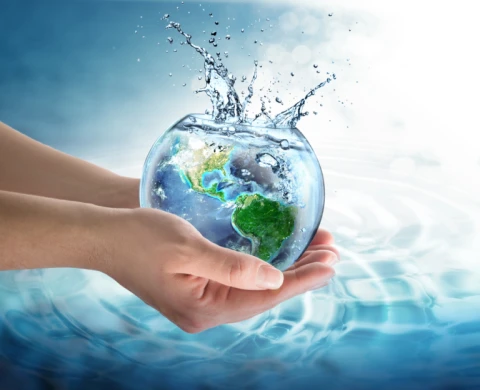
World Environment Day, celebrated every year on 5 June, is not merely a symbolic occasion on which we remind ourselves of our responsibilities toward nature. It is also an important opportunity to rethink the environmental, economic and social issues that will shape the future of humanity. Today, standing in the very midst of the colossal crises of the twenty-first century, we are confronted with the undeniable reality that the environment is no longer a matter of romantic nature conservation, but something far greater. The environment is, today, humanity's struggle for existence itself. Our relationship with nature is no longer merely a question of ecological balance; it has become a fundamental pillar forming the backbone of the economy, sociology, geopolitics and, beyond these, "national and global security."
The declaration of 2026 as a global "Year of Water" by the African Union together with the World Economic Forum is a noteworthy development. That the World Economic Forum, known for placing issues of economy, security and politics on the global agenda, has now brought water to the center of its agenda through its "Blue Davos" approach is certainly no coincidence. This shows that environmental problems have ceased to be ecological side issues and have moved to the heart of global politics. In fact, this shift has begun to give rise to new readings and new questions. What happened for the environment to suddenly be discussed in the security councils of states, the boardrooms of giant corporations, and center stage at international summits? Answering this question requires correctly reading the scale of the environmental threat, the repercussions of pollution, and the place of water in the new world order.
The first quarter of the twenty-first century has unfolded at an unprecedented pace, marked by one crisis after another. The coronavirus (Covid-19) pandemic, which caused shutdowns on a global scale, regional wars that upended supply chains, inflationary pressures and economic volatility, among many other problems, defined the central struggles of this period. Yet despite all of this, strategists agree on one chilling reality: the most critical tipping point that will determine the fate of humanity in the coming decades, and that will eclipse all existing crises, is the depletion of water resources and environmental problems.
Environmental Security
At this point, it is important to address the concept of "environmental security." The traditional understanding of security focuses on protecting borders with tanks, missiles and armies. Yet when the land turns to desert, rivers run dry, harvests collapse to nothing, and people, unable to find clean drinking water, are left struggling with epidemic diseases, the armies guarding those borders lose all meaning. Today, more than 2 billion people around the world lack access to safe drinking water. The drying of farmland through drought, desertification and a disrupted water cycle is not merely a topographical transformation. Moreover, this process, which sets millions of people in motion as they are forced to abandon their villages after agricultural production collapses, is laying the groundwork for a social problem that will be heard of ever more often in the coming years under the term "climate refugees/ climate-displaced persons."
United Nations (UN) data projects that over the next 30 years, hundreds of millions of people will be forced to migrate simply because they cannot find water or because they have lost their homes to extreme climate events such as floods and inundations. This picture, which shakes the demographic structures of countries, strains borders and gives rise to entirely new geopolitical conflicts, explains with great clarity why water is a security issue. The depletion or contamination of water resources in fact means the breakdown of food supply chains, deepening poverty, internal unrest, and the possibility that new "water wars" may erupt over transboundary waters such as the Nile, the Euphrates, the Tigris and the Indus.
In the past, states went to war over oil fields. The oil of the future, without doubt, is water. From energy to industry, from agriculture to technology, every system depends on this clear resource that has no substitute. For example, cooling the massive data centers (servers) at the heart of the digital age requires millions of gallons (several million liters) of fresh water every day.
The World Economic Forum's Blue Davos vision was born precisely out of this sense of desperation and awakening. Where Davos summits once discussed financial crises, free trade agreements or energy corridors, water security is on the table today for one simple reason: water is at once a source of economic growth, a vital element of security, and the center of social life.
On the global stage, the search for solutions to this crisis rests, in economic terms, on a tripod that can be described as the green, circular and blue economies. The "green economy," which places carbon emission reduction and renewable energy at its center, argues that development can proceed not in spite of the environment but together with it. The "circular economy" aims to dismantle the linear economy built on the ruthless "take-make-consume-dispose" mindset that has turned the planet into a dumping ground since the Industrial Revolution. It establishes a closed-loop system in which waste is not the final stop but is reintegrated into the production process as a new raw material. The "blue economy," for its part, holds that oceans, seas, lakes and rivers are not merely spaces for fishing or transport, and aims to turn aquatic ecosystems into an economic model through innovation. However, the success of all these macroeconomic models depends first and foremost on addressing gender inequality and injustice, which can be described as a sociological wound.
Environment and Women
When we talk about the water crisis, the language is usually a macro one, built around melting glaciers, drying reservoirs and declining agricultural productivity. Yet this crisis also has a human and social dimension. Within that dimension are thousands of people languishing under the weight of social culture and gender injustice. The UN's 2026 theme, "Water and Gender," and its telling slogan, "Where water flows, equality grows," shed light on the unjust nature of the climate crisis. For while the climate crisis affects everyone, it is also plain that it does not affect everyone "equally." Around the world, the water crisis strikes the poor hardest, and among the poor, it strikes women and girls hardest of all.
In many developing countries, particularly in Sub-Saharan Africa and rural parts of Asia, the task of bringing water home falls entirely on the shoulders of women and girls, as dictated by gender roles. In areas where no water flows from the tap, these women and girls must walk kilometers (miles) every day under the scorching sun, carrying jerry cans, just to reach clean water. According to UN reports, women and girls around the world spend hours, and often most of the day, collecting water. This is not merely a matter of lost time or physical exhaustion. It is a monumental deprivation of rights.
When a girl who should be at school, playing or studying spends those hours on the road to the well, what is stolen from her is not only her energy but her future, her dreams and her fundamental right to education. The number of girls who drop out of school because of difficulty accessing water is far from small. Meanwhile, when an adult woman spends most of her day fetching water, it becomes impossible for her to take part in economic production, to be present in political life, to acquire a profession or even to socialize. Moreover, the lack of access to clean water and adequate sanitation facilities (hygienic toilets) not only exposes women to the risk of physical assault but also invites maternal and infant deaths and a host of diseases.
Yet to see women solely as sorrowful victims of the water crisis, as passive casualties, would be shortsighted and a grave mistake. On the contrary, women, who have the most direct relationship with nature, who sow the fields, feed their families and must manage scarce resources, are also the most powerful and most innovative actors in the solution. Around the world, women are seen taking on pioneering roles in a wide range of innovative models, from environmental entrepreneurship and sustainable agriculture to local waste management cooperatives and rainwater harvesting projects. There is a story of success that stretches from women's committees in India reviving dried-up riverbeds to women farmers in Africa building green walls against desertification.
What deserves emphasis here is that women's participation in decision-making, whether in drafting environmental policy, planning water management budgets or taking part in climate negotiations, is not a mere call for a "quota" or for "equality." It is a rational and indispensable strategy for development, survival and security. No environmental policy that overlooks women's knowledge and experience can succeed. The formula is simple: empowering women protects the environment, and protecting the environment heals society from its very roots.
The Circular Economy and the Zero Waste Approach
When we bring this macro-level global picture home to our own land, to Türkiye, we are confronted with harsh realities that we urgently need to face. The first and most important thing to do in building environmental awareness in our country is to retire the great myth that has been taught to us in schools for generations and has become ingrained in our very genes: "Türkiye is a country surrounded by seas on three sides, rich in water and agriculture." No. Türkiye is not rich in water; on the contrary, it is a country under water stress.
According to international standards (the Falkenmark indicator), a country with more than 1,700 cubic meters of water per capita is classified as "water-rich," one with between 1,000 and 1,700 cubic meters as "water-stressed," and one with less than 1,000 cubic meters as "water-scarce." In recent years, figures for Türkiye have been calculated at between 1,300 and 1,350 cubic meters. These values clearly show that, by international indices, Türkiye officially falls into the category of water-stressed countries. If unplanned industrialization, flawed agricultural policies and the effects of climate change continue along this path, it is projected that by 2030 this figure will fall below 1,000 cubic meters and Türkiye will slide back into the status of a water-scarce country.
For precisely this reason, the Zero Waste Movement, which Türkiye, with its resources nearing the point of depletion, has strongly advocated and implemented in recent years in both domestic and international arenas, is far more than a recycling project. It is a vital doctrine of "resource conservation and security."
The UN General Assembly's declaration of 30 March as the "International Day of Zero Waste" under Türkiye's leadership, together with initiatives such as Istanbul Zero Waste Week, held each year on 1–7 June, reinforces Türkiye's diplomatic leadership in this field. However, as a society we must read the philosophy of zero waste correctly. Zero waste is not a shallow act of tossing a plastic bottle into a different bin instead of onto the street. Zero waste is directly linked to the concept of the "water footprint."
Behind every product we use in our daily lives lies an enormous amount of water consumed along the way, from the soil to our table or wardrobe; this is called the "water footprint." For example, producing an ordinary cotton T-shirt requires 2,700 liters of fresh water, from irrigating the cotton in the field to dyeing it in the factory. The same holds true, in different proportions, for a cup of coffee or a plate of food. So when you throw away an old T-shirt, pour leftover coffee down the sink or scrape the food on your plate into the trash, you are not wasting a mere "product." You are also throwing away the thousands of liters of clean water, the labor and the energy that went into producing it.
It is precisely at this point that the circular economy and zero waste approach come into play as a savior. Every product that is recovered, repaired, reused or never needed to be produced at all (because consumption was forgone) means that the tons of water that would have been spent on the production line and in field irrigation remain in the veins of nature and continue to flow in our rivers. At its core, zero waste is the most practical way to protect water and life.
For Türkiye, protecting water and nature is not a luxury environmental preference but a matter of national security and economic existence, one that bears on the nation's very survival. From high-level state policy to the civil society's work on the ground and the daily habits of individuals at home, what is needed is an all-out mobilization and a "revolution of mindset."
We must change our existing infrastructure systems, which smother our cities in concrete and channel rainwater straight into sewers and from there out to sea. We must transform our cities into "sponge cities" that absorb rainwater and replenish groundwater, make rainwater harvesting systems and the reuse of treated wastewater (greywater) in toilet flushing and landscaping a legal requirement in all newly constructed buildings, and expand green financing models that reward factories for installing "closed-loop" water systems that continuously treat and reuse water within the facility rather than using it once and discharging it.
Yet none of these legal regulations and technological infrastructure can ever succeed without public conviction and civic contribution. The solution must come to life not only in circulars issued in Ankara or at summits in Davos, but also at the kitchen sink, under the showerhead in our bathrooms, and in the stories we tell our children.
At the individual level, we need to rethink our daily habits. Acting with the knowledge that a tap left running while brushing our teeth wastes liters of water every minute, repairing leaks at home immediately, and moving away from the frenzy of unnecessary consumption toward a simpler way of life are our individual responsibilities. But going beyond this and standing shoulder to shoulder with civil society is the highest form of social contribution. Supporting an environmental association in our neighborhood, taking an active role in tree-planting campaigns, donating to long-established organizations such as ÇEKUD and TEMA, or joining a civic initiative that demands green spaces from local governments... None of this goes to waste. The love of nature and awareness of water that you instill in your child at home is the greatest and most valuable investment in this country's national security.
Protecting the environment is usually presented in our conversations under the guise of "leaving a clean legacy to future generations," a concept whose sense of belonging is postponed until tomorrow. This discourse breeds a dangerous complacency. Yet the point the climate crisis has reached is crying out a bitter truth to us. What we are trying to protect today is not only our grandchildren's inheritance but, quite directly, our own quality of life, our health, the food on our tables and our survival instinct, we who are today's adults. Without clean water and a healthy ecosystem, economic growth, bringing down inflation, lifting the stock market or inventing new technologies will mean nothing.
For this reason, 5 June, World Environment Day, is not a day for celebration, commemoration or window dressing. It is a day of action that is long overdue, a call to awaken.
Every conscious step we take from today, every repaired tap, every green initiative supported, every drop of water saved from waste, will be the sturdiest brick in the livable world of tomorrow. For, contrary to what has been assumed for centuries, the future will not belong to the largest armies, the most destructive weapons, or the tech giants that merely hold technology in their hands.
The future will belong to the societies that make peace with nature, bring the power of women into the process, transform their waste, and are able to protect that one drop of water at any cost.
