
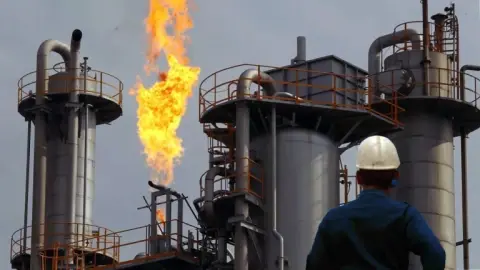
The world is undergoing a serious energy crisis.
The Russia-Ukraine war directly affects energy markets because Russia is one of the largest producers and exporters of oil, natural gas, and coal. Western countries leading sanctions aim to avoid financing Moscow’s war efforts by imposing various restrictions. In such an environment, the importance of alternative energy suppliers has increased more than ever, and attention has turned to countries bordering the Caspian Sea.
Azerbaijan and Turkmenistan are countries with significant natural gas reserves.
Currently, Azerbaijan exports natural gas to Türkiye, Georgia, Iran, Greece, Italy, and Bulgaria, and with reserves of 2.5 trillion cubic meters, it ranks as the world’s 12th largest natural gas reserve holder. Turkmenistan, on the other hand, has the world’s 4th largest natural gas reserves. Holding reserves of 13.6 trillion cubic meters, Turkmenistan exports natural gas only to Russia and China (according to 2021 data, 10.5 and 31.5 billion cubic meters respectively). A deal signed at the end of 2021 also decided to export 1.5–2 billion cubic meters of natural gas annually to Iran starting in 2022.
In 2021, Azerbaijan produced 31.8 billion cubic meters of natural gas, consumed 12.7 billion cubic meters (a small portion imported), and exported 19.6 billion cubic meters.
Turkmenistan produced 79.3 billion cubic meters, consumed 36.7 billion, and exported 42.1 billion cubic meters. Although these amounts are relatively small compared to Russia’s production and export figures, their role as alternatives is significant.
Azerbaijan’s largest natural gas export market is Türkiye.
The Baku-Tbilisi-Erzurum Gas Pipeline and the Trans-Anatolian Natural Gas Pipeline (TANAP) transport gas from Azerbaijan to Türkiye. Gas produced in the Shah Deniz 2 field is consumed in the Turkish market via TANAP and also exported to Europe. From the Southern Gas Corridor, which is part of TANAP and has a capacity of 16 billion cubic meters, 10 billion cubic meters go to Europe and 6 billion to Türkiye. Although during the project phase it was planned to increase capacity to 32 billion cubic meters and export 20 billion to Europe, the European energy crisis recently accelerated this increase. This will allow Europe to import more Azerbaijani gas. However, increasing exports from the current 10 billion to 20 billion cubic meters may take until 2027. This situation brings Turkmen gas back into focus as an alternative for Europe.
Delivering Turkmen gas to Türkiye, one of the largest consumers in the region, and further to European markets through Türkiye, has long been a planned but unimplemented goal.
One of the main reasons is the unresolved legal status of the Caspian Sea. This issue has provided Iran and Russia a solid basis to oppose potential projects. However, the “Convention on the Legal Status of the Caspian Sea” signed in 2018 brought some new solutions. Article 8.1 of the convention states: “The delimitation of the seabed and subsoil of the Caspian Sea into sectors shall be carried out by agreement between the littoral states, taking into account generally accepted principles and norms of international law, to enable the exercise of sovereign rights over the exploitation of the seabed and subsoil and other legitimate economic activities.” In other words, the littoral states have the right to develop and operate resources on the seabed they agree on.
Article 14 of the convention, directly related to pipelines, states that parties may lay cables and pipelines under the seabed, provided they comply with environmental standards.
These standards are determined according to international agreements the littoral states are party to and the Framework Convention for the Protection of the Marine Environment of the Caspian Sea. While this gives other littoral states the right to object to projects on environmental grounds, the fact that no project has yet been proposed since the convention’s signing in August 2018 raises questions.
The energy crisis affecting Europe and the world has brought Turkmen gas alternatives back to the agenda.
With Russian gas imports almost halted, European countries looking for new sources have turned their attention to Caspian littoral states, where Turkmenistan is an important player. During a period when EU policymakers and high-level government representatives of member states have made various visits and attempted to make agreements, a significant step was taken by Türkiye, Azerbaijan, and Turkmenistan. On December 14, Presidents Recep Tayyip Erdoğan, Ilham Aliyev, and Serdar Berdimuhamedow met in Turkmenistan to discuss Turkmen gas exports. The meeting raised the possibility of exporting Turkmen gas to Türkiye and Europe via the Southern Gas Corridor, i.e., TANAP, while stating that alternative projects, investments, and activities would be supported. The memorandum of understanding signed to strengthen cooperation in energy demonstrates the determination to take concrete steps and once again emphasizes the importance of energy security amid the ongoing crisis. In addition to energy, cooperation in trade, economy, transport, education, and culture is planned to be increased, and the summit will be reconvened soon. The second summit, planned to be held in Türkiye hosted by President Erdoğan, aims to take more concrete steps regarding natural gas supply.
This summit, held at a time when Europe and the world face a serious energy crisis, is significant as it shows Türkiye’s will to bring relevant parties together and unite them at the negotiation table, as seen in the Russia-Ukraine war and grain corridor agreements.
If the natural gas agreement is realized, Europe could replace part of its Russian gas imports, while Türkiye will add a new supplier to its portfolio, increasing supply security. Turkmenistan will strengthen its market security by reaching new markets beyond China, Russia, and Iran. Although the Turkmen gas export plan seems to be against Iran and Russia, it could also provide an opportunity to overcome sanctions they face. The possibility that Russia and Iran might sell natural gas via Turkmenistan and Azerbaijan through Türkiye may soon arise. Such a situation could accelerate Türkiye’s transformation into a natural gas trading hub. Therefore, it is necessary to be prepared for new developments...