
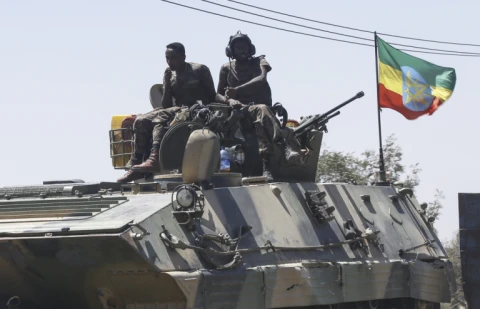
The conflict that began on 23 September 2026, when Tigrayan forces seized the airports of Mekelle, Aksum, and Shire, effectively brought the four-year fragile lifespan of the Pretoria Peace Agreement to an end. Yet interpreting this picture merely as a renewed civil war between Addis Ababa and Mekelle would mean overlooking the true center of gravity of the crisis. Ethiopia today is being challenged internally by the Alliance for Survival, formed by seven armed groups, while externally it is confronting a counter-front produced by the accumulation of threat perceptions that it has itself generated over the past five years. Its dam policy on the Nile has pushed Egypt in this direction. The space opened to the Rapid Support Forces (RSF) during the Sudan war has done the same to Khartoum. And the rhetoric defining access to the Red Sea as a "historical right" has similarly driven Eritrea into alignment.
In its pursuit of regional hegemony, Addis Ababa has simultaneously encroached upon the security domains of its neighbors. Over time, the separate concerns of these neighboring states have evolved into a common strategic ground. This ground has three layers. The first is the Egypt-Sudan axis, shaped by the Nile Basin and the war in Sudan. The second is the western shore of the Red Sea, organized around fears concerning Assab. The third is the impact of Ethiopia's deepening relations with the United Arab Emirates (UAE) and Israel, which has further sharpened regional polarization. When these layers converge with Ethiopia's internal vulnerabilities, the line between civil war and regional war in the Horn of Africa becomes increasingly blurred.
The Nile and Sudan Axis: The Backlash from Opening Space to the RSF
Ethiopia's position in the Sudan war is one of the least discussed yet most consequential dimensions of the crisis. Since April 2023, Addis Ababa has officially maintained neutrality in the war between the Sudanese Armed Forces (SAF) and the RSF. However, evidence revealing the existence of a camp in Benishangul-Gumuz where RSF fighters were being trained points in the opposite direction. In addition, Yale University's Humanitarian Research Lab documented, through satellite imagery, activity at an Ethiopian military base in Asosa consistent with military support for the RSF. Sudanese Chief of Staff Yasser al-Atta has accused Ethiopia of opening its territory to RSF drones and of turning Sudan's war into an opportunity to seize border territory. This accusation indicates that, from Khartoum's perspective, the issue is no longer merely an intelligence suspicion but a question of overt state policy. The disputed al-Fashaga region adds a historical dimension to this picture.
At this point, the Nile connects the Sudan issue directly to Egypt's core security agenda. Sudan's position throughout the Grand Ethiopian Renaissance Dam process has historically fluctuated. Khartoum moved back and forth between the potential benefits of regulated water flows and concerns over security and data sharing. The RSF issue has the potential to bring that fluctuation to an end. A Sudanese army that views Ethiopia as an actor fueling the war is far more likely to align with Egypt's position on the Nile. When the Egypt-Sudan military cooperation agreement signed in 2021, Cairo's support for the SAF, and Ethiopia's announcement of new dams in the Nile Basin are considered together, the convergence of the two downstream states on the same front acquires a structural basis.
The paradox here is clear enough. By opening space for the RSF in the Sudan war, Ethiopia may have sought to expand its influence along its western frontier in the short term. Yet this choice also shows that it has transformed its counterpart in Khartoum into a lasting adversary and given Cairo an ally that demonstrates it is not alone on the Nile issue. Moreover, the Blue Nile and Benishangul-Gumuz line has now become a security vulnerability for Ethiopia itself. The presence of the Benishangul and Gumuz movements within the Alliance for Survival shows that this grey zone along the Sudanese border can operate in both directions. Indeed, the geography used to destabilize a neighbor can now be turned against Ethiopia with the same instruments. Ethiopian President Taye Atske Selassie's accusation at the UN General Assembly that "external actors" were responsible for the fighting suggests that Addis Ababa has recognized this backlash but prefers to externalize responsibility.
The Western Shore of the Red Sea: The Assab Fear and the Eritrea-Centered Counter-Front
From Eritrea's perspective, the Ethiopian threat is not an abstract possibility but a scenario that has been taking concrete shape for years. Ethiopian Prime Minister Abiy Ahmed's October 2023 speech describing access to the Red Sea as a "historical right" was interpreted in Asmara as a direct threat of war. This perception was reinforced by Assab's location on Eritrea's southern coast, far from major population centers and more difficult to defend. Ethiopia's deployment of mechanized units and heavy weaponry in the Afar region, within striking distance of Assab, led Asmara to plan on the basis of a worst-case scenario.
Field observations in Addis Ababa in November 2025 and February 2026 revealed continuous military transfers from the capital toward the north. This activity signaled preparation for a protracted confrontation on the northern front. During the same period, open-source analyses also documented a federal military buildup around Tigray and debated whether this could represent preparation for a war that might expand to include Eritrea. The developments unfolding today have moved in the direction indicated by those earlier field observations.
Eritrea responded to this threat through a pragmatic rapprochement with its historical enemy, the Tigray People's Liberation Front (TPLF). It deepened its three-decade-long alliance with Egypt, aligned itself with the Sudanese army, and improved relations with Saudi Arabia through Egyptian mediation. The United States' decision on 19 September to lift sanctions on the Eritrean military and the ruling party broke Asmara's international isolation. Eritrea thus became the geographical and military link in the emerging alignment against Ethiopia. Addis Ababa continues to claim that the alliance operates with Eritrean financial support.
The western shore of the Red Sea has therefore acquired a new geopolitical meaning. Egypt, Sudan, and Eritrea view Ethiopia's search for maritime access as a challenge to their sovereignty and maritime security. Djibouti occupies a more complicated position. Its role as the main gateway for Ethiopian foreign trade ties it economically to Addis Ababa. Yet Ethiopia's search for alternative ports through Somaliland and Assab threatens Djibouti's revenue model. Addis Ababa's attempts to instrumentalize Afar nationalism also pose a separate risk for Djibouti, whose stability rests on a delicate balance between its Afar and Issa communities. In short, all of the coastal states, albeit to varying degrees, perceive Ethiopia's Red Sea agenda as a security concern. The current situation in Afar is the internal reflection of this tension. While the regional administration is fighting alongside federal forces, a local armed group has aligned itself with Tigrayan forces. The case of Afar commander Ibrahim Osman Aliyu, who crossed into Eritrea with a special forces unit in 2025, demonstrates that the Afar card can also be turned against Addis Ababa.
The Logic of Bloc Formation and the Limits of Addis Ababa
What gives meaning to the emerging alignment against Ethiopia is Addis Ababa's own partnerships on the opposite side of the Red Sea. The UAE played a decisive role in the federal government's military superiority during the 2020–2022 war through its provision of unmanned aerial vehicles (UAVs). Today, it is still regarded as Ethiopia's most important external supporter. Israel, meanwhile, took a step that further increased instability in the Red Sea by recognizing Somaliland in December 2025. It also signed an intelligence cooperation agreement with Ethiopia and elevated bilateral relations to the highest level with President Herzog's visit to Addis Ababa in February 2026. Although open sources do not contain clear indications that Israel has assumed a direct military role in the current conflict, observations from the field point to a different picture. However, the UAE-Ethiopia-Israel rapprochement has been decisive in creating the perception of an opposing bloc in the region. This perception has translated the differing motivations of Egypt, the Sudanese army, Eritrea, and Saudi Arabia into a common strategic language. What is observed on the ground suggests that positioning in East Africa is increasingly being defined through relations with Israel. This binary does not explain the choices of every actor on its own, but it provides a strong analytical framework for understanding the axis along which regional polarization is becoming sharper.
Even so, this picture does not mean that the Abiy government is heading toward collapse. The federal government retains its superiority in manpower and technology. It has also expanded its UAV capabilities by launching domestic production. The TPLF, by contrast, surrendered a significant portion of its heavy weaponry during the Pretoria process. More importantly, the Tigrayan front, which forms the backbone of the Alliance for Survival, is not a unified bloc. Over the past two years, Tigrayan politics has effectively fractured into three camps. The first consists of the TPLF led by Debretsion Gebremichael and the Tigray Defence Forces (TDF) under its control. This is the structure currently conducting the war. The second is the federal-aligned line led by Getachew Reda. Its armed manifestation on the ground is the Tigray Peace Force (TPF), which broke away after opposing the TPLF's preparations for war and its rapprochement with Eritrea, and which now operates along the Afar border. The third consists of senior military figures who remained undecided between the two poles. Tadesse Werede, the commander-in-chief during the previous war and former head of the interim administration, was among them. The detention by armed men of four senior military leaders skeptical of the war, including Werede, suggests that the TPLF leadership is attempting to eliminate this middle group and consolidate control over Tigray in a single center.
This move may accelerate decision-making in the short term. Yet the least discussed, and perhaps most decisive, dimension of the crisis is the attitude of the Tigrayan people. The TPLF's legitimacy has already been eroded by hunger, displacement, and unpaid compensation. On top of this comes the Eritrean factor. During the 2020–2022 war, the massacres carried out by Eritrean forces in Tigray, above all in Aksum, as well as widespread sexual violence, were documented by international human rights organizations. This trauma remains fresh in Tigray's collective memory. Voices emerging from the field suggest that a large segment of the population does not support the TPLF-Eritrea rapprochement. The clearest indication of this reaction is the significant recent movement of Tigrayans out of the region, particularly toward Addis Ababa. In other words, part of the population does not regard the TPLF's war as its own. The seizure of the airports, which has eliminated the possibility of leaving the region by air, will increase pressure on the population that remains.
This will have direct consequences for the course of the war. First, the broad mobilization achieved during the previous war through a sense of existential defense will not be replicated as easily this time. Recruitment will become more difficult and morale on the front lines more fragile. Second, the population's distance from the TPLF-Eritrea alliance may create space for the detained undecided generals and their circles to gain popular support. If this camp begins acting together with the TPF, the TPLF could find itself facing a second front within Tigray itself. Third, Addis Ababa will be able to use this tension as political leverage to separate the TPLF from the Tigrayan people. In the previous war, Tigray resisted the federal government as a single society. This time, the TPLF is confronted not only by the federal army but also by the silent objection of its own society.
Fault lines are also visible in the rest of the alliance. The Fano-TPLF dispute over Western Tigray remains unresolved. The Oromo Liberation Army (OLA), meanwhile, describes the alliance not as a political agreement but as a "procedural consensus." There may also be a strategic calculation behind the OLA's cautious position. Abiy Ahmed is Ethiopia's first Oromo prime minister, and the Oromo currently occupy what is historically their strongest position at the center of state power. Although the OLA is fighting the Abiy government, the possibility that a post-Abiy transition could be shaped predominantly by Tigrayan and Amhara actors who held power in the past is a serious source of concern within the Oromo political sphere. It would therefore not be surprising if the OLA preferred limited participation focused less on overthrowing the center and more on protecting its gains in its own region. Finally, the United States' decision this year to impose sanctions on the TPLF leadership, together with its warning that further sanctions could be imposed on those contributing to escalation, constrains the opposition's international room for maneuver. Taken together, these factors suggest that in the short term the alliance possesses the capacity to erode federal power across multiple fronts rather than to overthrow the central government.
For Türkiye, this landscape presents both risks and opportunities. Thanks to its strong relations with Addis Ababa, its deep presence in Somalia, and its normalized relations with Egypt, Ankara is one of the few actors capable of maintaining dialogue with both sides of this divide. The Ankara Declaration of December 2024 demonstrated this capacity. In the period ahead, Türkiye's priorities fall under three headings. The first is managing the risk of spillover into Somalia, which has increased with the Ogaden National Liberation Front's (ONLF) participation in the alliance. The second is keeping dialogue channels open in order to prevent the Nile dispute from becoming part of the war. The third is activating humanitarian diplomacy and mediation capacity at an early stage. Ethiopia's current predicament offers a striking example of how the pursuit of regional hegemony can turn into encirclement when the security concerns of neighboring states are ignored. Whether this encirclement evolves into a regional war will depend largely on the decisions taken in Asmara and Cairo.