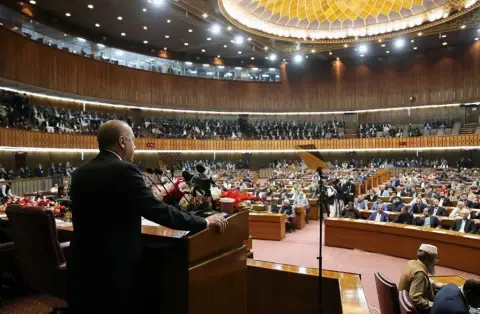
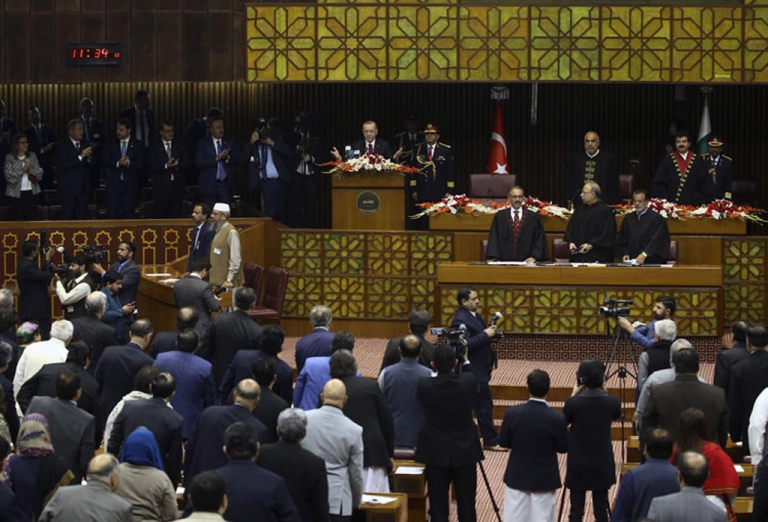
 President of Turkey Recep Tayyip Erdogan attends a joint session of National Assembly and Senate in Islamabad, Pakistan on February 14, 2020.[/caption]
Erdoğan is an exceptional leader, and people around the world listen to him closely. He does not refrain from weighing in on critical issues or taking initiative. On the one hand, he criticizes the unjust order that prevails in the world today. On the other hand, he speaks for the oppressed peoples and Muslims around the globe – whether they are in Myanmar, Kashmir, Syria, Palestine or Somalia. If necessary, Erdoğan speaks openly about the mistakes of the United States and other great powers – as he did about Jerusalem and Palestine. He does not stop at criticism either. In recent years, Turkey became a world leader in humanitarian assistance. The country mediated many crises and on other occasions, sided with the righteous side – even if mildly. Erdoğan distinguished himself as a leader starting with the 2009 World Economic Forum, where he criticized Israel's policy of occupation. He builds on that momentum by involving himself in international crises.
In my opinion, Erdoğan sets an example in the eyes of many people around the world, and he will be used as a point of reference for decades to come. He started by fighting against the domestic guardianship regime to promote civilian politics in Turkey. Then, he cracked down on groups like FETÖ, which outside powers used to meddle in Turkey's internal affairs. Finally, Erdoğan pursued an autonomous and active foreign policy to protect Turkey's national interests. His autonomy from the Western alliance and in other cases, his search for new forms of cooperation were met with surprise. His ability to have a seat at the great powers' table and to criticize them received much appreciation. People noticed the Turkish president for his political style, which blended the national interest with the welfare of the ummah. Needless to say, his audacity entailed many risks and challenges to his rule. Especially since 2013, Turkey encountered turbulence, emanating from the outside, as well as a labeling campaign in the international press. Erdoğan's leadership, which challenged conventional wisdom, came to be defined by various smears – which did not weaken Erdoğan's popularity. The Turkish president took immense risks at a time of regional and global turbulence to move his country forward. If anything, his ability to overcome challenges and bring about a major transformation in Turkey amazes people.
Erdoğan's leadership is a case that will be discussed for a long time. His example will create a legacy for politicians at home and abroad.
President of Turkey Recep Tayyip Erdogan attends a joint session of National Assembly and Senate in Islamabad, Pakistan on February 14, 2020.[/caption]
Erdoğan is an exceptional leader, and people around the world listen to him closely. He does not refrain from weighing in on critical issues or taking initiative. On the one hand, he criticizes the unjust order that prevails in the world today. On the other hand, he speaks for the oppressed peoples and Muslims around the globe – whether they are in Myanmar, Kashmir, Syria, Palestine or Somalia. If necessary, Erdoğan speaks openly about the mistakes of the United States and other great powers – as he did about Jerusalem and Palestine. He does not stop at criticism either. In recent years, Turkey became a world leader in humanitarian assistance. The country mediated many crises and on other occasions, sided with the righteous side – even if mildly. Erdoğan distinguished himself as a leader starting with the 2009 World Economic Forum, where he criticized Israel's policy of occupation. He builds on that momentum by involving himself in international crises.
In my opinion, Erdoğan sets an example in the eyes of many people around the world, and he will be used as a point of reference for decades to come. He started by fighting against the domestic guardianship regime to promote civilian politics in Turkey. Then, he cracked down on groups like FETÖ, which outside powers used to meddle in Turkey's internal affairs. Finally, Erdoğan pursued an autonomous and active foreign policy to protect Turkey's national interests. His autonomy from the Western alliance and in other cases, his search for new forms of cooperation were met with surprise. His ability to have a seat at the great powers' table and to criticize them received much appreciation. People noticed the Turkish president for his political style, which blended the national interest with the welfare of the ummah. Needless to say, his audacity entailed many risks and challenges to his rule. Especially since 2013, Turkey encountered turbulence, emanating from the outside, as well as a labeling campaign in the international press. Erdoğan's leadership, which challenged conventional wisdom, came to be defined by various smears – which did not weaken Erdoğan's popularity. The Turkish president took immense risks at a time of regional and global turbulence to move his country forward. If anything, his ability to overcome challenges and bring about a major transformation in Turkey amazes people.
Erdoğan's leadership is a case that will be discussed for a long time. His example will create a legacy for politicians at home and abroad.
[Daily Sabah, 18 February 2020]