
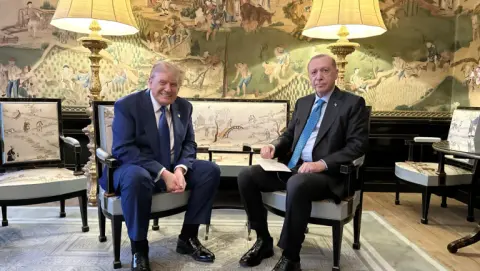
Turkish President Recep Tayyip Erdoğan and his U.S. counterpart Trump will meet at the White House on Sept. 25, 2025. Before the meeting, it might be helpful to provide a projection of the bilateral relationships and what it could look like in the future.
1. How are Turkish-American relations evolving during Trump 2.0?
A cautious optimism prevailed in Türkiye-U.S. relations during the first eight months of Trump's second tenure in the White House. Considering the “letter” crisis during his first term and the financial attack on Aug. 11, 2018, Trump 2.0 is taking a moderate approach. Indeed, despite using tariffs as a sanction tool, Trump kept tariffs on Türkiye at a minimal level. Tom Barrack, appointed as the U.S. ambassador to Ankara, took Türkiye's sensitivities into account on issues related to Syria and the PKK.
While progress was made on Türkiye's F-16 procurement, Trump took a moderate approach to the delivery of F-35s. Ankara, meanwhile, has approved American liquefied natural gas in the energy sector to reach the $100 billion trade goal. It has also involved American companies in energy projects. Most importantly, the participation of an American company in the Zangezur Corridor, within the Azerbaijan-Armenia peace deal, did not cause any issues.
During Trump's election campaign, his statements about Türkiye's exclusion from the F-35 program, due to the S-400 procurement, were made in a way that blamed Barack Obama. Despite the anti-Turkish Jewish, Greek, and Armenian lobbies in the Senate, it is expected that Trump will take a pro-Türkiye stance on issues within presidential authority. For these reasons, the meeting between Trump and Erdoğan on Sept. 25, 2025, is expected to take place in a positive atmosphere. However, it is also known that the two leaders have disagreements on some issues.
2. What agenda items can be covered during the Sept. 25 meeting?
President Erdoğan said they would discuss various topics, including trade, investment, and the defense industry. A $100-billion trade target was also mentioned. The current trade volume of $32 billion can only be increased to a limited extent due to customs duties. However, purchases like passenger aircraft, defense industry products, and liquefied natural gas could boost trade volume. Türkiye's 2024 import and export figures were $16.2 billion and $16.4 billion, respectively, in Türkiye's favor. It had a surplus in 65 of the 97 categories of exports and imports. However, due to the steel tariffs imposed during Trump's first term as president, Türkiye has a trade deficit of $1.8 billion with the U.S. in the area. Türkiye also has a deficit in the organic chemicals and pharmaceutical sectors. Its decision on Sept. 21 to ease customs duties on the U.S. is strengthening expectations for normalization. Therefore, the two heads of state will develop solutions to achieve the target in light of the current tariffs. Energy and defense are emerging as the two most promising areas.
In the energy sector, meanwhile, there are two key topics. Energy and Natural Resources Minister Alparslan Bayraktar met with U.S. Energy Secretary Chris Wright in Milan, Italy, on Sept. 10, 2025, to discuss areas of cooperation. It is now known that an agreement has been reached with U.S. companies, regarding gas and oil purchases, and options for joint projects in third countries. The contribution of U.S. companies to Türkiye's energy exploring fleet campaign, launched in Africa, Central Asia, the Black Sea, and the eastern Mediterranean, especially in Libya and Somalia, will likely be on Trump's agenda. This partnership, which Türkiye views positively due to the political implications of potential joint projects, could be finalized on Sept. 25.
In the defense industry, the strong focus on the F-16 and F-35 fighter jets is rightly on finding solutions. However, the U.S. and Türkiye are also competitors in this industry. The Turkish defense sector can produce weapons systems that the U.S. sells to Europe but at a much lower cost and higher quality. Currently, KAAN and HÜRJET, MLRS with smart ammunition, rocket systems, cannons and howitzers, armored vehicles, UAVs, drones, and air/UAV defense systems are cost-effective options. In addition to Trump's emphasis on the fighter jets sales and his hopes for passenger aircraft exports, exploring how competition in these areas can lead to cooperation can be an important issue.
Alongside these topics, the Russia-Ukraine War, the Azerbaijan-Armenia Peace Process, and developments in Syria seem to be issues where the two leaders agree. There is no tension between Türkiye's constructive approach to Azerbaijan-Armenia peace and the U.S. policy of engaging in the Caucasus. However, it would be helpful that this process is conducted in a spirit of cooperation. Iran and Russia's anti-American asymmetric moves in the southern Caucasus are likely to be on both leaders' agendas.
The Ukraine-Russia war also unites both presidents. Although Trump met with Putin in Alaska in an effort to end the war, it is clear that Russia has maximalist intentions. Therefore, a disappointed Trump sees Erdoğan as an option for engaging with Putin. President Erdoğan's successes in the grain corridor, prisoner exchange, and facilitation align with Trump's vision. However, given Putin's intentions, Ukraine remains a complex issue that will take time to resolve.
Israel's plan to occupy and annex the West Bank and Gaza remains the most contentious issue on the agenda. It is uncertain how Türkiye and the U.S. – with differing views on Gaza – will handle the Palestinian question. Trump's invitation to Erdoğan for a meeting on Gaza during the U.N. General Assembly is significant. Israel's aggressive actions in the region and its perceived genocide will likely be on their agenda. Netanyahu's remarks against Türkiye and his provocations toward the Greek-Greek Cypriot duo are also issues Erdoğan cannot ignore. At this stage, the conflict prevention mechanism between Israel and Türkiye may need to be updated to curb Israel's actions. The U.S. may also need to play a constructive role here. Egypt's military buildup in Sinai further supports this expectation.
Another issue involves the current developments in Syria. Syrian President Ahmad al-Sharaa's strategy of restraint continues. The priority is to preserve the country's integrity, ensure social cohesion, and accelerate the economic and political transition. However, the separatist agenda of the PYD/YPG and a Druze tribe is disrupting Syria's unity. Türkiye's interests and security concerns are also aligned with al-Sharaa's agenda. At this point, Ankara expects an end to Israel's provocations and occupation, the implementation of the March 10 protocol, and the full lifting of sanctions. Trump needs to support this expectation, which aligns with U.S. policy. Indeed, Trump seems to be on the same page.
3. How will Erdoğan and Trump view the emerging global politics?
Trump's “China complexity” is evident. It is known that Türkiye plans to join BRICS and the president also attended the last meeting of the Shanghai Cooperation Organization. Trump, however, wants a Türkiye that is not aligned with China and Russia. Türkiye has been criticized in the past for an "axis shift" and "strategic autonomy," as it seeks a clear policy shift in its favor from the U.S. Therefore, it must be stated that Türkiye will continue its unique balancing act. Indeed, the U.S., which does not grant Türkiye privileged country status in trade and does not consider Türkiye's sensitivities in regional security issues, should not expect major concessions.
Despite the reality, the U.S. and Türkiye share the same interests in the three-region-three-sea regional systems where Türkiye is located, with three exceptions. These three exceptions are the result of the U.S.’ misguided policies. The first area of competition concerns Israel. Israel, backed by all kinds of U.S. support and aid, is a source of instability. The second area of exceptional competition is formed by Greece and the Greek Cypriots. The agreement on defense cooperation and the lifting of the arms embargo on the Greek Cypriots clearly target Türkiye. The final area of competition is the fact that the PYD/YPG, the Syrian branch of the PKK, is still seen as an ally by the U.S. If the two heads of state can resolve these three conflicts of interest, the decadeslong engagement between Türkiye and the U.S. – marked by ups and downs – can be brought to a manageable level. Türkiye expects to be treated transparently, fairly, and justly.
4. How aware is Trump of the significance of US relations with Türkiye?
Trump's approach to governance, based on "commercial politics," does not place Türkiye in a unique position. Reaching an agreement with Türkiye could be seen as a way for the U.S. to gain income. Close ties with Türkiye can also lead countries that view it as a threat to make concessions to the U.S. Greece holds a notable position in this context. Meanwhile, American diplomats refer to Türkiye as a “strategic partner” that should remain aligned with the U.S. on regional issues.
Türkiye's independent actions in Libya, Syria, the Caucasus, and Africa are considered an "obstacle" by the U.S. For Trump, Türkiye is a regional power that needs to be kept in check. Aware of Erdoğan's personality, Trump aims to repair the relations with Ankara that the Democrats damaged and to influence the region through it. The Syrian aspect also stems from this goal. Ultimately, Trump knows he can't fully trust the PKK/PYD. However, his support for Israel and silence on its attacks in other countries reveal the contradictions in his approach.
5. How indispensable is the US for Türkiye?
The U.S. remains a superpower despite its troubled domestic politics and unpredictable foreign policy. Its military power is effective enough to reshape global balances. The U.S. is increasingly concerned about China's rise, but it still sets the norms of global politics. Its economic power also supports this privilege. Therefore, U.S. politics must be closely monitored. In an environment where elephants are fighting, a policy of balance can be sustained to a certain extent.
In this situation, Türkiye does not pay much attention to U.S. foreign policy when an existential threat is at stake. When any “situation” erupts in the three regions and three seas, where Türkiye is located, it can impose a Syria-like scenario on the competition between Russia and the U.S. Therefore, it is important to maintain balanced and dignified relations with Russia, while finding the minimum common ground with the U.S. Türkiye's ability to do so has been particularly valuable in peace efforts regarding Ukraine. However, as seen in the cases of the PKK, Greece/Greek Cypriyot, and Israel, whenever the U.S. and Türkiye find themselves on opposing sides, the latter has the capacity to generate its own solution. Therefore, the desired outcome for the two countries is to find common ground.
It seems unlikely that Türkiye would make concessions just to win U.S. sympathy. As in the case of Syria, Türkiye has the power to shape the field, join the game when the time comes, and control the outcome. However, when Washington takes a constructive step, Ankara does not leave such goodwill unrequited.
