
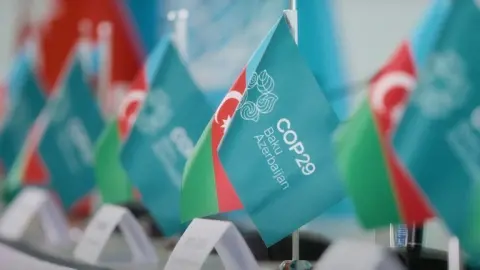
The international community is preparing for the 29th Conference of the Parties (COP29), which will be held between November 11 and 22. The main agenda of this year's climate summit, where countries that are parties to the United Nations Framework Convention on Climate Change (UNFCCC) meet annually, is climate finance. However, it is clear that this will not be the only topic discussed at the summit. The ongoing Russia-Ukraine war, Israel's inhumane actions in Palestine, the new front it has opened in Lebanon, and finally, the US presidential election that ended on November 5 are some of the geopolitical developments expected to have an impact on the conference. In addition, the extreme rainfall that affected Spain in the last days of October clearly highlighted the importance of the upcoming climate summit. The disaster serves as a warning to all stakeholders, especially governments, about the potentially devastating effects of global warming and climate change.
COP29 Agenda
COP29 is holding its 29th meeting this year to address a long-awaited issue: climate finance. The conference had already begun to be referred to as the “Finance COP” months in advance. The failure to bring financing up to the desired level since 2009 has been one of the most fundamental issues. In addition, the fact that countries have different expectations has led to discussions about the transfer of resources.
COP15, held in Copenhagen, ended with a promise from developed countries to provide $100 billion in climate finance annually to developing countries by 2020 to combat climate change. The acceptance by industrialized countries, which have the largest share of historical emissions caused by humans, to take on a significant portion of the responsibility has been one of the fundamental provisions of climate agreements since the UNFCCC. Least developed countries, which have had the least impact on global warming and climate change, are extremely sensitive to the issue of financing because they are the countries most affected by the negative consequences.
The actions for which financing is provided fall into two categories: emission reduction and adaptation. In this context, one of the biggest criticisms of the least developed countries is that a large portion of climate financing, which has not yet reached the desired level, is allocated to emission reduction projects. According to the latest assessment report by the Intergovernmental Panel on Climate Change, this ratio is 90 percent. For these countries, which are most vulnerable to numerous adverse effects of global warming, such as abnormal rainfall patterns, severe droughts, forest fires, and rising water levels, adaptation to climate change is more critical than emission reduction. Serious discussions are expected at the conference to ensure a more equitable transfer of resources tailored to the needs of different country groups.
Another issue regarding financing is the “loss and damage fund.” As the name suggests, this fund aims to compensate the countries most affected by climate change for the losses and damages they have suffered. For over a decade, this fund, which has been demanded by least developed countries in particular, has aimed to compensate for the fact that a large portion of climate finance is directed toward greenhouse gas emissions. After lengthy negotiations, this fund was taken up as a main agenda item at COP28 but was postponed in the conference's final statement to be discussed in more detail at COP29. It is expected that the least developed and developing countries with urgent financing needs will also be influential on this issue at the conference.
However, it is likely that the reliability of any decision on financing will remain in question. This can be understood by looking back at the past, as at the conference held in 2009, it was decided that developed countries would mobilize $100 billion in climate finance annually until 2020. However, this decision was only implemented in 2022. Today, it is estimated that developing countries need between $500 billion and $1 trillion in financing annually. With inflation rising worldwide, it seems difficult for developed economies to reach this target today. Finally, it is expected that the issue of countries updating their national intent statements with more ambitious climate targets will be discussed at the conference. At COP28, held in Dubai last year, the first Global Stocktake Report was prepared, and countries were expected to submit their updated statements to the UNFCCC Secretariat by 2025. The outcome document, which included headlines from the assessment report, stated that a fair, equitable, and orderly transition was targeted, taking into account the different needs of countries based on their varying levels of economic and social development. For this reason, it was decided to gradually reduce the use of fossil energy sources rather than completely ending it. Another decision included in the final statement was to triple the world's installed capacity based on renewable energy sources. Accordingly, at COP29, it will be discussed that countries need to update their national intent statements in line with these decisions in order to continue their efforts to combat climate change.
Geopolitical Developments Likely to Affect the Conference
The Russia-Ukraine war, which will mark its third year on February 24 if no ceasefire is declared, and Israel's ongoing full-scale attacks in Palestine, which have been ongoing for over a year, are among the hottest topics likely to influence the conference. Both conflicts are being discussed in climate debates in terms of their impact on energy markets and the environmental problems they cause.
Another development that will undoubtedly have an impact on the conference is the US presidential election, which ended on November 5. Republican candidate Donald Trump, who won the majority of votes against Democratic Party candidate Kamala Harris, was elected the 47th US president. Trump is known for his differing statements on climate change during his previous term in office. One of his first acts after taking office was to withdraw the US from the Paris Climate Agreement. While Joe Biden has re-engaged the US in the agreement, there is a possibility that Trump may withdraw from it again. During his election campaign, Trump expressed this desire on several occasions. While it is rumored that Biden, who will remain in office until January 2025, will not participate in climate negotiations, it is known that the country's delegates are trying to take precautions against the possibility of the Trump administration sabotaging the process. It is expected that the conference will emphasize the US's commitment to global climate change efforts, and this step is considered important in terms of maintaining the support of other countries. In particular, as the US is the country with the largest share of historical emissions, it is expected that it will fulfill its responsibility in terms of climate finance, especially for many countries, particularly the least developed countries.
The floods that occurred in Spain in late October are also expected to be among the topics discussed at the conference. The event, which occurred in the south of the country and caused the deaths of more than 200 people, is significant in several ways. As is well known, Spain is considered a developed country by many actors, including the United Nations. The problems that could arise from the global climate fund being allocated primarily to emission reduction activities have been experienced very severely by a developed country. Beyond the environmental damage caused by the disaster, the loss of life and injuries suffered by many people show the extent of destruction that global warming can cause if no action is taken. Valencia is important because it is one of the cities that generates income for the country, visited by thousands of tourists every year. It is an indisputable fact that the city, which received rainfall equivalent to approximately one year's worth in a very short period of time, was inadequately prepared for the negative effects of global warming. In addition to the unpredictability of disasters, it is clear that more effort is needed to minimize vulnerabilities. While the damage caused by this flood alone is estimated to exceed $30 billion, it remains to be seen whether Spain will make efforts to allocate more financial resources to global warming adaptation activities at the conference.
Hosting Discussions
Azerbaijan, which will host COP29, is known to be one of the major oil and natural gas producing and exporting countries in the region. The extent to which the organization, which has been hosted by hydrocarbon-producing countries such as the United Kingdom (Glasgow), Egypt (Sharm el-Sheikh), and the United Arab Emirates (Dubai) over the past three years, contributes to the fight against climate change is also a subject of considerable debate. These countries consume large amounts of oil and natural gas and derive a significant portion of their income from the sale of these resources. Azerbaijan, which derives approximately 90% of its national income from oil and natural gas revenues, has appointed its current minister of environment and natural resources, who has worked in the hydrocarbon industry for many years, as conference president, which, as in previous years, has been a source of concern and debate.
One of the key factors in achieving the 1.5-degree Celsius target set to prevent global warming and climate change from reaching an irreversible point for all of humanity is fossil fuel consumption. According to scientists and climate advocates who have been calling for an end to the use of fossil energy sources since the Paris Agreement, the countries in question are hosting the conference and exerting pressure to ensure that the decisions taken are in line with their interests. Whether the conference, hosted by Azerbaijan, will achieve its goals this year will become clear in the coming days.