The contemporary international system is navigating an era marked by profound uncertainty, shaped by multilayered crises, geopolitical rifts, and an escalating wave of global disruptions. This period is not only characterized by the intensification of known risks but also by the proliferation of “unknown unknowns.” In other words, both states and international organizations are now confronted with structural disturbances beyond their immediate awareness.
In this context, actors who seek to present alternatives to the Western-centric global order are expected not only to challenge the existing institutional architecture but also to construct novel normative frameworks. BRICS+ (comprising Brazil, Russia, India, China, South Africa, Egypt, Ethiopia, Indonesia, Iran, and the United Arab Emirates) emerges in this regard not solely as an economic powerhouse, but also as a normative project aspiring to advance a multipolar world order. Through its expanded membership, BRICS+ advocates for the enhanced representation of the Global South, while simultaneously positioning itself as a candidate for a new geopolitical and normative center amid global uncertainties.
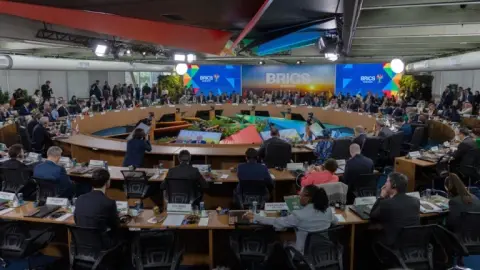
This report, prepared in the context of the 17th BRICS Leaders’ Summit held in Rio de Janeiro on July 6-7, critically examines the positioning of BRICS+ in ongoing global and regional crises by exploring the tension between its normative ambitions and geopolitical realities. The report evaluates how conflicts such as Gaza, Sudan, Egypt-Ethiopia, Israel-Iran, the India-Pakistan, and Russia-Ukraine, as well as the global economic competition between the United States and China, shape BRICS+'s strategic posture. Furthermore, it analyzes how emerging collaborations in artificial intelligence and digital infrastructure signal the bloc’s evolution into a multidimensional governance alternative. In this framework, each contribution interrogates BRICS+ as both a product and a challenger of the emerging world order.
Mustafa Caner — Sakarya University, SETA
Is Iran using its BRICS membership as a strategic balancing tool against the West, or does it signal a permanent shift in Tehran’s foreign policy orientation?
Long positioned in opposition to Western-led institutions, Iran has viewed organizations such as BRICS and the Shanghai Cooperation Organization (SCO) as critical platforms for promoting its ideological and strategic narratives. Iran’s accession to BRICS in early 2024, however, presents a complex case due to the ideological and geopolitical diversity among member states. Tehran has leveraged its close ties with China as a shield against U.S. sanctions, while simultaneously deepening commercial partnerships with non-Western actors to mitigate its economic isolation. China, as the principal importer of Iranian energy exports, plays a central role in this realignment, particularly in the domains of infrastructure, non-dollar trade, and productive investment—areas that challenge the dollar’s hegemony and the broader U.S.-centric financial system. This trajectory reflects Iran’s broader foreign policy emphasis on multilateralism and strategic autonomy. However, whether this shift represents a long-term reorientation or merely a tactical move remains an open question.
The July 2025 BRICS Summit in Rio de Janeiro carried significant symbolic weight for Tehran, occurring in the aftermath of a 12-day military escalation between Iran and Israel. At the summit, Iranian Foreign Minister Abbas Araghchi invoked Iran’s right to self-defense, condemning Israeli and U.S. aggression. While the summit declaration refrained from naming specific actors, its condemnation of attacks on Iran was interpreted by Tehran as a partial yet meaningful affirmation of its international legitimacy.
Yahya Amir
Somaville University
Can BRICS build an alternative financial architecture for developing countries? How is the role of the New Development Bank shaping up in this context?
BRICS could be a catalyst for a better and more functional financial infrastructure for developing countries. The current dollar-centric and SWIFT-dependent global financial system leaves developing countries—which have virtually no say in the system—vulnerable to sanctions and uncontrollable vulnerabilities. BRICS, on the other hand, can encourage trade in local currencies, develop alternative payment systems, and establish reserve pooling mechanisms to create room for maneuver for its members in the face of politically motivated embargoes and sanctions. The fundamental problem here is that BRICS members are structurally different from one another. This shows that full integration may not always be possible. However, a decentralized solution that works can provide greater financial autonomy by freeing countries from their dependence on Western-led financial institutions.
In this context, this year's summit marks the transition of the New Development Bank (NDB) from a conceptual formation to concrete applications. The bank is expanding its membership structure and focusing on lending in local currencies, becoming a reliable development finance actor in long-term and sustainable infrastructure projects. These developments position the NDB as a less partisan and more impartial development partner, while also creating a channel through which developing countries can stand on their own without being dependent on each other. Thus, BRICS' goal of creating a reliable and impartial financial alternative for the Global South is being translated into concrete steps through this institutional transformation.
Erman Akıllı
Ankara Hacı Bayram Veli University, SETA
How effective can the emphasis on digital autonomy in the fields of artificial intelligence and digital governance at the 2025 BRICS Summit be in preventing the marginalization of the Global South in the field of technology?
The joint declaration issued following the 17th BRICS Leaders Summit, hosted by Brazil on July 6-7, 2025, draws attention to the deepening digital asymmetry on a global scale and calls for inclusive cooperation, particularly in the field of breakthrough technologies, especially artificial intelligence. The statement defines artificial intelligence as a critical turning point in terms of development and emphasizes that global artificial intelligence governance must “reduce potential risks” and take into account the needs of all countries, especially those in the Global South. This emphasis underscores the desire to create an alternative to Western-centric norms in AI governance, while also strongly expressing the need to prevent developing countries from being marginalized in the accelerating technology race.
The declaration also emphasizes that artificial intelligence must be developed “in accordance with national regulatory frameworks and the United Nations Charter, and within the framework of respect for state sovereignty.” This approach reflects BRICS's determination to realize its vision of digital autonomy without directly conflicting with international norms.
On the other hand, a similar trend is noticeable in the declaration in terms of data governance. The text reinforces the pursuit of digital autonomy centered on the interests of developing countries by proposing a global framework that includes the principles of “respect for national data sovereignty” and “secure, mutually agreed cross-border data flows.” It also highlights the strategic importance of a “resilient, secure, inclusive, and interoperable digital public infrastructure” in terms of large-scale service delivery and social value creation.
The emphasis on sovereignty and the United Nations Charter in the declaration shows that BRICS countries are inclined to transform existing norms of the global order in line with their own interests rather than disregarding them.
In conclusion, while BRICS has firmly articulated its goals of reducing digital asymmetry and building digital autonomy, the transformation of these goals from rhetoric into concrete strategies and institutional capacity will only be possible with strong political will and collective action. Otherwise, there is a risk that this ambitious vision will remain symbolic.
Translated with DeepL.com (free version)
Tunç Demirtaş
Mersin University, SETA
Does BRICS+ propose an alternative value system to the normative order dominated by the West? Or is it merely a bloc based on mutual interests?
Since its establishment in 2009, BRICS has been an organization that has carried criticism of the Western-centered global order. It also advocates multipolarity and aims to increase the representativeness of the Global South. The foreign policy priorities, governance structures, and ideological commitments of the founding members—Brazil, Russia, India, China, and South Africa—were actually quite different from one another. Furthermore, with the recent expansion to include Egypt, Ethiopia, Iran, and the United Arab Emirates, this diversity has been further enriched by the addition of monarchies, theocratic regimes, and fragile democratic structures. This situation has brought about even greater ideological diversity within BRICS+. In short, the resulting picture makes it quite difficult to establish a common value system.
Indeed, BRICS+ member countries are trying to develop an approach that questions the global governance and political and economic structures dominated by the West. In doing so, they are acting with the intention of proposing an alternative value system based on principles that prioritize multilateralism, inclusiveness, and development. However, differences in interests and politics among BRICS+ members remain obstacles or limitations to the practical implementation of this intention. Additionally, it is noteworthy that BRICS+ is increasingly taking on a hybrid structure. That is, it is becoming a strategic cooperation platform that combines both ideological and pragmatic dimensions and instrumentalizes multipolarity rather than serving as an anti-Western platform.
As a result, it is argued that BRICS+ currently appears to be a pragmatic power bloc based on interests, seeking to balance the value system established by the West rather than offering a positive alternative to it. However, with the deepening crisis of legitimacy in global governance, it is possible that BRICS+ will eventually undergo a transformation, moving beyond mere opposition to producing alternative principles and norms.
Kadir Temiz
ORSAM President
Can BRICS offer an alternative global governance model to the current international order? What position should Türkiye take in this process?
BRICS, which has been back on the agenda with the 2025 Brazil summit, continues to claim to build an alternative discourse and practice to the current international order. Although it is not fully institutionalized, it stands out as a platform that promotes multipolarity and makes the demands of the Global South more visible.
BRICS' greatest contribution is its potential to be the voice of countries harmed by the global neoliberal order. As the community transforms into a more inclusive structure through its expansion process, it also has the potential to reform the fundamental institutions of the post-World War II international order, such as the International Monetary Fund (IMF), the World Bank, and the United Nations, or to create a new institutional framework. This situation may encourage not only competition between countries but also a review of existing institutions.
However, BRICS also has significant weaknesses. First and foremost, the frequent reduction of the “global justice” discourse to anti-US sentiment, particularly due to the decisive role of China and Russia, gives the alliance the appearance of a bloc conflict. Additionally, as seen in examples such as India-China, there are deep conflicts of interest among members. For this reason, BRICS faces serious challenges involving both internal institutional restructuring and external criticism.
Nevertheless, the common discourse that emerges on certain security and diplomatic issues, such as the attacks on Gaza and Israel's attacks on Iran, also hints at the potential for security cooperation. In this context, it would be appropriate for Türkiye to maintain a cautious but constructive distance from alternative formations such as BRICS, while taking into account regional and global balances.