
Brain drain is a multidimensional phenomenon reflecting the cross-border movement of human capital. The methodologies employed to measure this movement often yield different results based on the data source and the primary focus of the research. This study conducts a comparative analysis of TÜİK’s administrative records against the outputs of the Fragile States Index (FSI), a prominent international risk indicator.
Türkiye TÜİK Brain Drain Data
To comprehend the actual scale of brain drain in Türkiye, the most fundamental source is TÜİK data, which monitors the overseas residency status of higher education graduates. Rather than relying on survey-based estimates, these figures represent concrete administrative data derived from matching graduation records with population registries. As illustrated in Figure 1, there has been a consistent upward trend in the proportion of university graduates departing from Türkiye. While the migration rate of graduates stood at 1.6% in 2015, this figure reached 2.0% by 2024.
Türkiye FSI Brain Drain Index
In contrast to the rising trend observed in TÜİK data, the "Human Flight and Brain Drain" score within the Fragile States Index follows a different trajectory for Türkiye (Figure 2). The FSI measures national vulnerability on a scale of 0 to 10; a higher score indicates heightened structural risks and signifies that instability factors, such as brain drain, have reached a more critical threshold. According to FSI data, while Türkiye’s brain drain risk score peaked at 4.9 in 2018, it declined to 3.6 in 2024. Understanding the calculation methods of the FSI and its specific brain drain indicator is crucial at this juncture.
The inverse relationship between these two datasets is rooted in methodological differences. The FSI is not a direct migration census; rather, it is a "risk and perception" index. The index utilizes a risk assessment software called CAST (Conflict Assessment System Tool), which performs content analysis by scanning over 10,000 global media sources and reports. If public discourse regarding brain drain diminishes in a country's media or if there is a perceived easing of socio-political fragility, this is reflected as an improvement in the FSI score. Consequently, the FSI measures the pressure of general instability on human capital rather than solely counting physical departures.
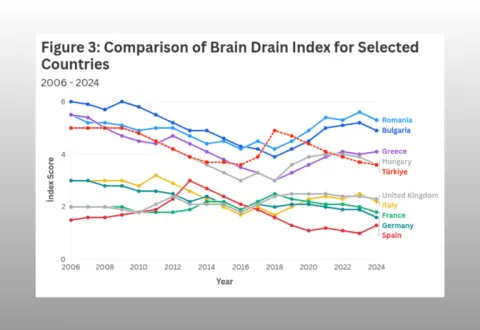
Comparison of Brain Drain Index for Selected Countries
Türkiye’s FSI brain drain index offers a striking comparison when viewed alongside neighboring countries and continental averages (Figure 3). As of 2024, Türkiye’s score of 3.6 is lower than those of neighbors such as Romania (5.3), Bulgaria (4.9), and Greece (4.1). Conversely, it remains significantly behind developed nations like Germany (1.6) and France (1.8). However, in recent years, Türkiye's score has moved notably closer to European averages.
Globally, brain drain dynamics vary significantly based on regional economic stability and mobility opportunities (Figure 4). On a global scale, South Asia (6.0) and the Middle East and North Africa (4.5) emerge as regions with the highest brain drain risks. European scores (3.5), which remain below the global average, have shown a slight increase in recent years, contrary to other continents. Meanwhile, the North American region (1.1) remains well below the global average, following a trend parallel to global shifts.
In conclusion, Türkiye’s brain drain profile is characterized by a relatively positive performance within global risk indices. The significant improvement in FSI scores since 2018, combined with a more stable risk rating compared to many of its neighbors, displays the country’s structural potential for retaining its human capital. The current data suggests that through strategic initiatives, this qualified workforce can be successfully transformed into a source of domestic productivity.