
PANEL | DECEMBER 21, 2015
| Moderator | Ufuk Ulutaş, SETA |
| Speakers |
|
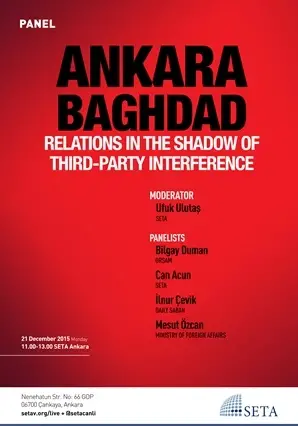
Moderated by Ufuk Ulutaş, Director of Foreign Policy Research of SETA, a panel discussion titled "Ankara-Baghdad Relations in the Shadow of Third-Party Interference" took place in SETA Ankara on 21st of December.
First panelist, Bilgay Duman from Middle East Research Center ORSAM, gave a general introduction of the domestic issues and politics of Iraq. Duman stated that since the capture of Mosul by DAESH, the internal balance in Iraq has been changing. It was also noted by Duman that Maliki’s try to build monopoly led to Sunni exclusion from the political process, thus some Sunni Iraqis tend to support DAESH as an alternative to the state. Duman added that "Iraq is not able to fight DAESH on its own. Here Iran was the first third-party actor to intervene and to increase its influence, not only politically but also in military aspects in supporting Shia militias of Hashd al Shabi". According to Duman, all these changing actors and structures played an active actor role in the current Bashika crisis. Duman continued in claiming that Turkey wanted to enhance its relations with Iraq but Iran’s efectivity in domestic issues always have been an obstacle in enabling Abadi to implement his policies. As an example of a crisis between Iraq’s central government and Hashd al Shabi militias, Duman pictured the operation in Ramadi, where some groups rejected to take part. Duman concluded his speech by saying that he thinks that "the recent crisis is related more to domestic disputes of Iraq".
Mesut Özcan, Head of Diplomacy Academy of Turkish Ministry of Foreign Affairs, introduced from as an academic the perspective of Turkey’s position on the current crisis. Özcan remarked that these operations are actually done because of the security thread of DAESH towards Iraq’s unity. "Other actors are also allowed throught this thread to engage into this crisis effectively", told Özcan the audience, and added that "Turkey always preferred a dialogue with Abadi’s administration". Mr Özcan also noted that the issue of Turkish troops based in Bashika was exaggerated by the media and added that Iraq’s security and the regional peace is very important for Turkey, as Iraq is one of the most important economic partners of Turkey.
Third panelist, Ilnur Çevik from Daily Sabah, focused mainly on the KRG in Northern Iraq, giving a historical background insight. He mentioned that Turkey tried to reconcile between Talabani and Barzani who were in conflict in 1990s. According Çevik, the first Turkish military existence in Bashika took place in 1997. Mr Cevik said that after Saddam’s collapse there were continuing unification attempts between Kurdish parties in which Turkey tried to help. Çevik stated that "Turkey also send about 1500 soldiers to Bamarni, to build a training camp for local groups, which is still continuing his facilities". Çevik said that thus Turkey was vvry surprised by Abadi’s questioning of the reason behind the existence of Turkish troops in Northern Iraq. According to Çevik, Barzani who is fighting on different fronts and has problems with the central administration does need the support of Turkey.
The last panelist, Can Acun, Foreign Policy Researcher at SETA talked about the role of DAESH in this issue. Despite than Iran and Iraq, according to Acun, Turkey’s position in evaluating DAESH relates also on its socio-economic background. "The bases which were provided to to DAESH terrorist led to a further emergence. The main problem here is partly created by this different point of views on DAESH", told Acun. He also added that Maliki’s failed administration led to more marginalisation of DAESH and criticised him of supporting the terrorist organisation and its expansion in Syria. Acun concluded by saying that the Bashika crisis happened in aiming to attempt to exclude Turkey from the Iraqi and Syrian context, as well as from fighting against DAESH.


