
What are the impacts of BRICS on the global economy?
The idea of BRIC was first proposed by Goldman Sachs banker Jim O’Neill. In a 2001 report, O’Neill
argued that the countries he referred to as BRIC (Brazil, Russia, India, and China) were poised to drive
global economic growth over the next decade. This projection proved accurate, in part due to the
commodity supercycle. Between 2000 and 2011, the group’s share in global production rose from 8% to
19%. The rise of BRICS (with the inclusion of South Africa), or more recently BRICS+, has become
increasingly significant in recent years, particularly in terms of its influence on global politics. Today,
BRICS is seen as representing a shared belief among rising powers in opposition to the
Western-dominated global economic system.
According to 2023 data, the BRICS members have the following characteristics in terms of gross domestic product (GDP) based on purchasing power parity: Brazil is the world’s 8th largest economy and a major agricultural exporter. Russia is the 5th largest economy with vast mineral resources, hydrocarbon reserves, and the largest arable land. India is the world’s 3rd largest economy, a leader in information technology, and the most populous country. China is the largest economy and the second most populous country, also the leading exporter (the world’s factory). South Africa ranks as the 23rd largest economy and is rich in various natural resources, including diamonds. As of 2023, BRICS countries account for 46% of the world’s population, 43% of oil production, 25% of global exports, and 29% of the world’s GDP.
Today, BRICS collectively produces nearly one-quarter of global GDP and constitutes a massive global
market encompassing 46% of the world’s population (approximately 3.21 billion people).
What topics are expected to be highlighted at the BRICS Summit?
BRICS heads of state convene annually, with each country assuming the one-year rotating presidency to
determine priorities and host the summit. The bloc operates on a consensus-based decision-making
mechanism and remains largely informal—there is no formal charter, secretariat, or common fund. The
order of BRICS meetings typically follows the acronym's sequence. However, in 2024, due to the addition
of new members in 2023, the leaders’ meeting will be held in Kazan, Russia, from October 22–24.
Key issues expected at this year’s summit include de-dollarization in international trade and regional
conflicts. Notably, in a period when Russia is being diplomatically isolated, the attendance of numerous
heads of state from the Global South is of particular importance. At the center of this summit is the
intergovernmental group now known as BRICS+. In addition to the five founding members (Brazil, Russia,
India, China, and South Africa), five new countries (Egypt, Ethiopia, Iran, Saudi Arabia, and the UAE)
joined or were invited in January 2024. The 16th BRICS Summit is significant as it marks the first summit
with the participation of these new members.
Recently, Russian President Vladimir Putin stated that thirty additional countries have expressed interest
in joining BRICS. Countries such as Azerbaijan, Bahrain, Bangladesh, Belarus, Bolivia, Algeria,
Kazakhstan, Cuba, Myanmar, Nigeria, Pakistan, Senegal, Syria, Thailand, Venezuela, and Vietnam have
reportedly applied for membership. Indonesia, which had previously applied and then withdrew, is also
among the waiting candidates. Türkiye, one of the most recent applicants, stands out for seeking to strike a
balance between East and West. As a NATO member, Türkiye also distinguishes itself from other
prospective members.
Who will attend the summit?
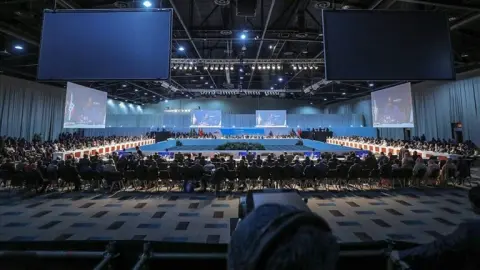
The BRICS Summit officially commenced in Kazan on October 22. This major foreign policy event holds
both symbolic and material importance for Russia. According to Russian Deputy Chief of Staff Yuri
Ushakov, delegations from 36 countries, including 22 heads of state, as well as UN Secretary-General
António Guterres, are expected to attend. Leaders from China, India, South Africa, Egypt, Türkiye, Iran,
and Palestinian Authority President Mahmoud Abbas will be present.
The leaders of BRICS member states and other summit participants were welcomed at the airport by
President of the Republic of Tatarstan, Rustam Minnikhanov, with traditional bread, salt, and chak-chak.
The first day of the summit, October 22, was dedicated to discussions among delegation heads on
enhanced cooperation in trade and the potential expansion of BRICS membership. Russian President
Putin met with Chinese President Xi Jinping, Indian Prime Minister Narendra Modi, South African
President Cyril Ramaphosa, Egyptian President Abdel Fattah el-Sisi, and BRICS New Development Bank
President Dilma Rousseff.
Although two more intensive summit days remain, Western analysts are already highlighting Russia’s
diplomatic success. According to U.S. think tanks, Russia’s strategic partnerships with rising powers such
as India and China, and the expansion of BRICS as an alternative to the G7, could significantly influence
global politics and reflect Putin’s commitment to building a multipolar world order.
What is the significance of the summit for Türkiye?
Recent visits by Turkish Foreign Minister Hakan Fidan to China and Russia, along with statements from
President Recep Tayyip Erdogan and his planned visit to Kazan on October 23 for the BRICS Summit,
indicate Türkiye’s interest in deepening its ties with BRICS. This potential membership could foster
stronger economic relations with countries like China and India. Considering Türkiye’s nearly 40-year-long
wait for EU membership, BRICS, with its forward-looking potential, may offer an attractive alternative for
economic cooperation. However, this does not imply a withdrawal from the EU Customs Union or existing
trade agreements with Western states. Türkiye’s primary trade axis has always been with the West, as
evidenced by current export and import figures. Still, BRICS represents a platform with future potential and
could provide Turkish investors and producers with access to new markets. If Türkiye joins BRICS, it would
be the first NATO member to do so. This could positively reshape BRICS’s image, transforming it from an
Eastern alliance to a more inclusive coalition that could attract Western countries as well.
Türkiye’s potential BRICS membership may raise concerns among some EU countries but is unlikely to
fundamentally impact its Western relationships. BRICS’s membership criteria are flexible and do not
require measures that would harm Türkiye-EU relations. Moreover, BRICS is an economic, not military,
organization. For Türkiye, joining BRICS would be a geopolitically significant decision, given its role as a
bridge between East and West and its interest in expanding economic ties with Asian countries. Türkiye’s
interest in BRICS should therefore be interpreted by its NATO allies and Western partners as part of this
strategy. Türkiye is not seeking an alternative to NATO as a security alliance.
President Erdogan is expected to hold bilateral meetings with the leaders of Russia, China, and India
during the 16th BRICS Summit in Kazan. These talks will likely address bilateral relations, Türkiye’s future
within BRICS, and the roles it may assume within the group.
What outcomes can be expected from the summit?
The BRICS Summit will primarily focus on strengthening multilateralism, integrating new members, and
resolving regional conflicts. The first day will feature two sessions on enhancing multilateral cooperation.
Delegates will also discuss the resolution of regional conflicts, financial interactions within BRICS, and the
potential for currency transfers. On October 23, President Putin is expected to hold bilateral meetings with the presidents of Türkiye and Iran, Recep Tayyip Erdogan and Masoud Pezeshkian, Ethiopian Prime
Minister Abiy Ahmed Ali, and other leaders of member states. On October 24, a session titled “BRICS and the Global South: Building a Better World Together” will focus specifically on the Middle East. Putin will also hold bilateral meetings with the presidents of Palestine, Laos, Mauritania, Bolivia, the Republika
Srpska, the UN Secretary-General, and the Prime Minister of Vietnam. The summit will conclude with the adoption of the Kazan Declaration. Representatives from 36 states and 6 international organizations will attend the event.
As the first summit with new members and one that brings together heads of state from many parts of the world, the BRICS Summit has already attracted global attention. It is expected to result in important
decisions regarding the use of national currencies in international trade, the development of new trade
routes, the possible expansion of BRICS, and the evaluation of new membership applications—all central to the vision of a multipolar world order.
23 October 2024
16th BRICS Summit (22-24 October 2024)
What are the impacts of the BRICS on the global economy? What are the expected highlights of the BRICS summit? Who will attend the summit? What is the significance of the summit for Türkiye? What outcomes should be expected from the summit?
